Yes — ultrasound is considered extremely safe. It uses sound waves, not ionising radiation, and standard diagnostic ultrasound has no known harmful effects on the body. That's exactly why it's the preferred scan in pregnancy for monitoring the baby. It's painless and needs no aftercare. As a sensible principle, scans are still done only when there's a medical reason — but there's no radiation dose to weigh up.
Key takeaways
- Ultrasound uses sound waves and has no known harmful effects.
- It uses no radiation, so nothing accumulates with repeated scans.
- It's the preferred, standard scan for monitoring pregnancy.
- It's painless, with no aftercare.
Of all the scans, ultrasound is the one you can be most relaxed about. Here’s why — and the few sensible caveats.
Why it’s so safe
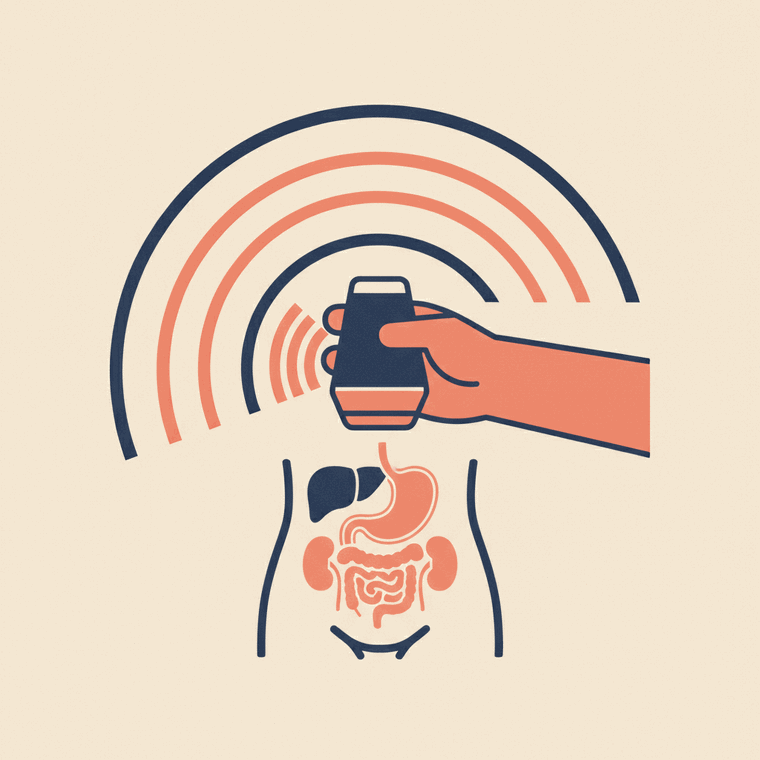
Ultrasound works with high-frequency sound waves, not the ionising radiation used by X-rays and CT.[1] Standard diagnostic ultrasound has no known harmful effects on the human body.[1] There’s:
- No radiation dose — so nothing to accumulate, even over many scans.
- No injection for a standard scan (some specialised ones use contrast, which is separate).
- No aftercare — you carry on with your day immediately.
The proof: pregnancy
The clearest evidence of ultrasound’s safety is that it’s the preferred imaging test in pregnancy, used to monitor the baby’s growth and wellbeing throughout.[1] A test wouldn’t be used routinely on developing babies unless it were considered very safe.
Sensible principles still apply
“No known harm” doesn’t mean scans are done for no reason. As with any test, an ultrasound is performed when there’s a medical purpose — but the decision is about whether it will help, not about balancing a radiation dose, because there isn’t one.[1]
Is there any discomfort?
Ultrasound is painless. You’ll feel the probe and cool gel moving over your skin, and pressure over a tender area can be briefly uncomfortable. Internal probes (transvaginal or transrectal) may cause minimal discomfort but shouldn’t be painful.[1]
Frequently asked questions
Is it safe to have many ultrasounds in pregnancy?
Yes — because ultrasound uses no radiation and has no known harmful effects, repeated scans are considered safe. The number you have is guided by your care needs, not a safety limit.[1]
Do the sound waves harm my baby?
There’s no evidence that diagnostic ultrasound harms a developing baby, which is why it’s the standard scan used to monitor pregnancy.[1]
Is ultrasound safer than an X-ray?
In terms of radiation, yes — ultrasound uses none, while X-ray uses a small amount. They’re used for different things, but where ultrasound can answer the question it’s often preferred, especially in children and pregnancy.[2]
Sources
- RadiologyInfo.org (RSNA & ACR) — General Ultrasound (benefits vs risks) — www.radiologyinfo.org/en/info/genus
- RANZCR / InsideRadiology — Ultrasound (Coombs) — www.insideradiology.com.au/ultrasound-hp/