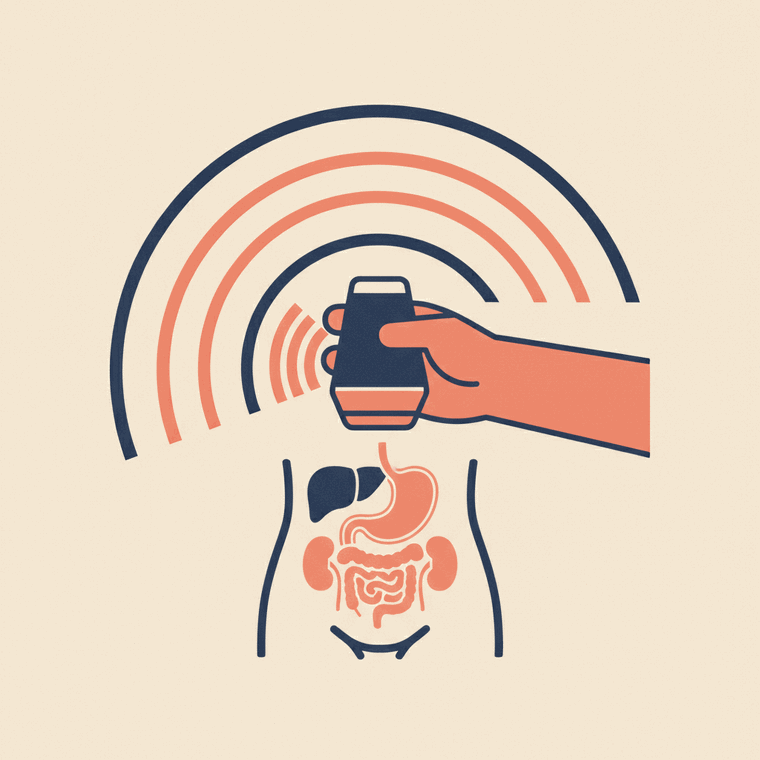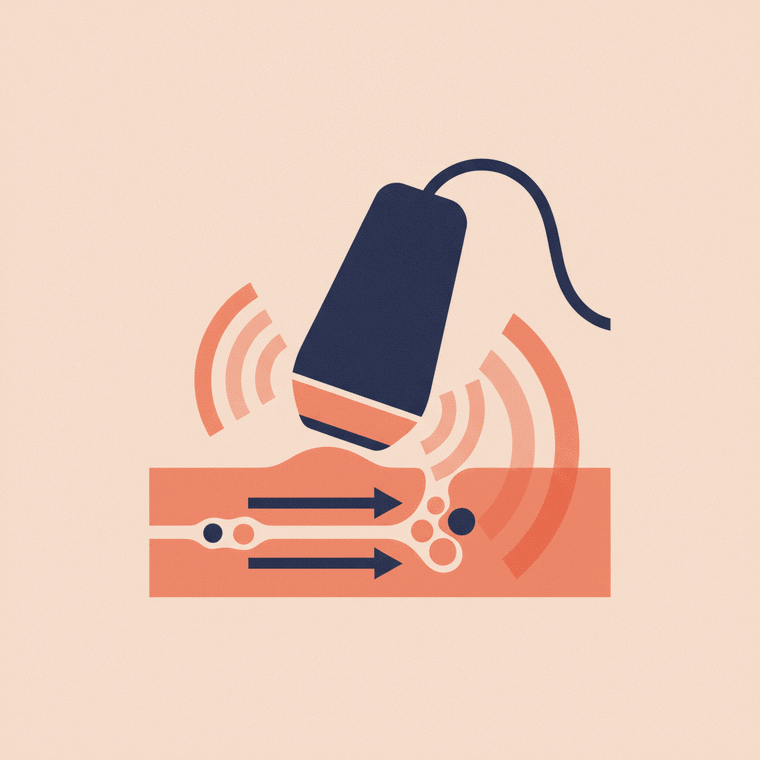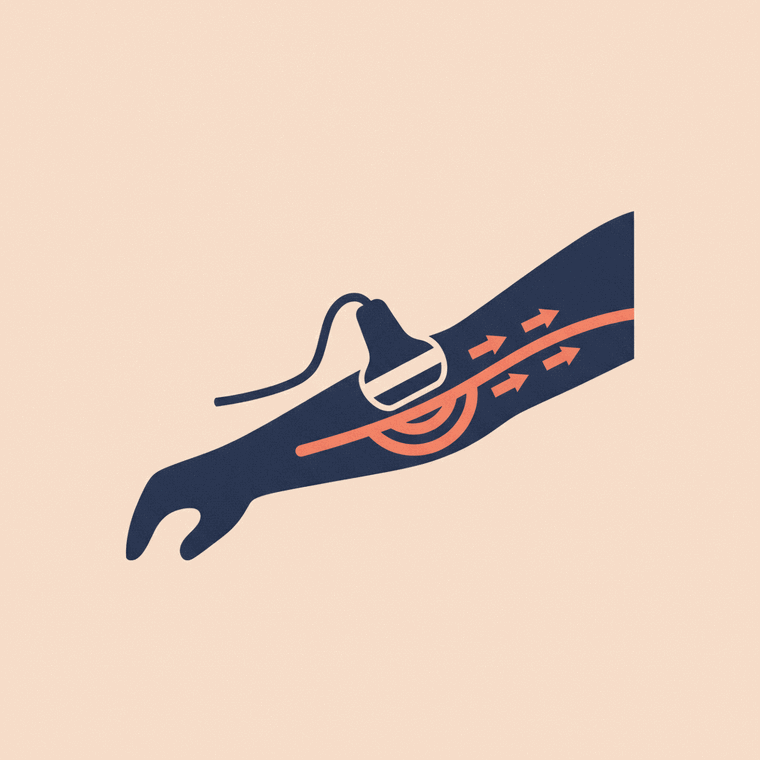
An arterial Doppler is an ultrasound of the arteries that measures how blood is flowing — often in the legs, to check circulation and look for narrowed or blocked arteries (peripheral arterial disease). It uses sound waves, not radiation, is painless, and sometimes uses blood-pressure cuffs to compare flow at different points. It usually needs no special preparation.
Key takeaways
- An arterial Doppler checks blood flow through the arteries.
- It's often used for leg circulation and narrowed arteries (PAD).
- It uses sound waves and shows flow in real time — no radiation.
- Pressure cuffs are sometimes used to compare flow; it's painless.
An arterial Doppler is an ultrasound of the arteries — the vessels that carry blood away from the heart — and it measures how well blood is flowing through them, with no radiation.[1]
What it’s for
It’s most often used to assess circulation, particularly in the legs, where narrowed or blocked arteries (peripheral arterial disease, PAD) can cause:[1]
- Pain in the legs on walking that eases with rest
- Cold feet, or slow-healing wounds and ulcers
- Weak or absent pulses
By showing the speed and pattern of flow, an arterial Doppler can reveal where an artery is narrowed and how much it’s affecting the blood supply — which helps decide whether treatment, such as opening the artery, is worthwhile.[1]
What to expect
A sonographer applies gel and moves the probe along the artery. For a leg study, blood-pressure cuffs are sometimes placed at different points on the limb to compare pressures and pinpoint a narrowing.[1] You may hear the pulsing flow as sound. It’s painless and usually needs no special preparation.
Its limits
As with all ultrasound, sound doesn’t travel well through bone or gas, and very deep arteries can be harder to assess — in which case CT or MRI angiography may be used.[1]
Frequently asked questions
What does an arterial Doppler check for?
How well blood is flowing through your arteries — commonly to look for narrowing that affects circulation, such as in the legs (peripheral arterial disease).[1]
Is it painful?
No — it’s painless. Gel and a probe are moved over the skin; sometimes pressure cuffs are used to compare flow, which just feels like a blood-pressure check.[1]
Sources
- RadiologyInfo.org (RSNA & ACR) — General Ultrasound (Doppler) — www.radiologyinfo.org/en/info/genus
- RANZCR / InsideRadiology — Ultrasound (Coombs) — www.insideradiology.com.au/ultrasound-hp/