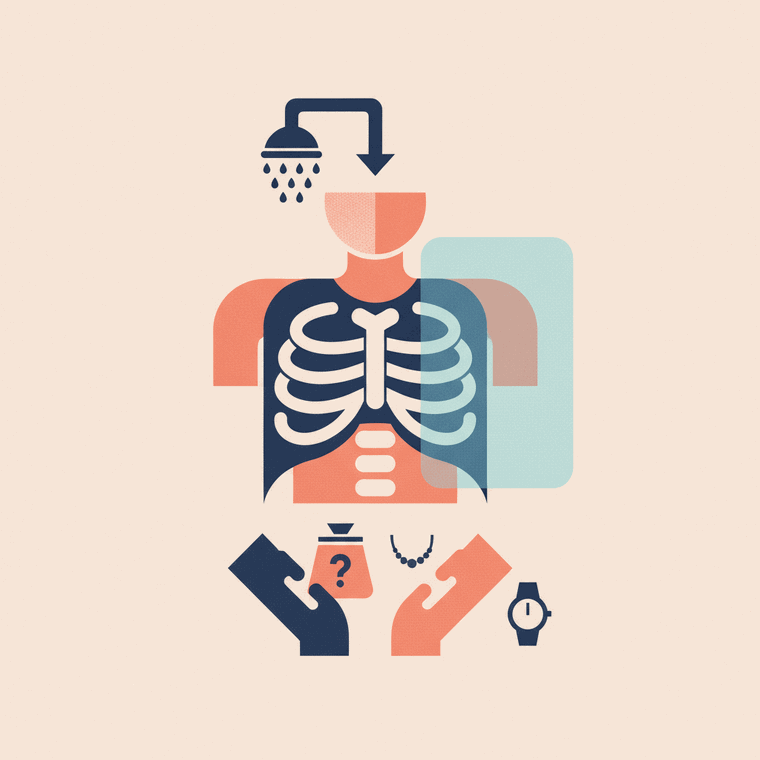
Most plain X-rays need no preparation — no fasting, no injection, nothing to drink. The main thing is to remove metal over the area being X-rayed (jewellery, zips, underwire, some clothing), because metal shows up brightly and can hide the picture. You may change into a gown. Always tell the radiographer if you are, or might be, pregnant. Only special X-ray studies that use contrast — like a barium swallow — need extra preparation.
Key takeaways
- Most plain X-rays need no preparation and no fasting.
- Remove metal over the area — it can obscure the image.
- Tell staff if you are, or might be, pregnant.
- Only contrast studies (e.g. barium swallow) need special prep.
One of the conveniences of a plain X-ray is that there’s usually nothing to prepare — no diet, no drink, no injection.[1] Here’s the short list of what to know.
Remove metal over the area
The main thing is that metal shows up bright white on an X-ray and can obscure what’s underneath.[2] So you’ll be asked to remove metal over the part being X-rayed:
- Jewellery, watches, hairclips, glasses
- Belts, and clothing with zips, buttons, or underwire
- For some X-rays, you’ll change into a gown to be sure
Tell staff if you could be pregnant
As with any X-ray, tell the radiographer if you are, or might be, pregnant, so they can confirm the scan is needed and use shielding where appropriate.[1]
On the day
The radiographer positions you, may ask you to stay still or hold your breath (for a chest X-ray), and the image takes a moment. There’s no aftercare, and you can return to normal activities straight away.[1]
The exceptions: contrast studies
A few X-ray procedures do need preparation — the ones that use a contrast agent to look at moving parts of the body. A barium swallow or bowel study, for example, may involve fasting and drinking a contrast liquid.[1] Your clinic will give you specific instructions for these; they’re different from a standard “plain” X-ray.
Frequently asked questions
Do I need to fast for an X-ray?
No — plain X-rays need no fasting. Only special contrast studies (like a barium swallow) have preparation, and your clinic will tell you in advance.[1]
Why do I have to take off my jewellery?
Metal absorbs a lot of the X-ray beam and shows up as bright white, which can hide the area being examined. That’s why metal over the scan area is removed.[2]
Can I drive and go back to work after an X-ray?
Yes — a plain X-ray has no aftercare and no lingering effects. You can carry on with your day immediately.[1]
Sources
- RANZCR / InsideRadiology — Plain radiograph / X-ray — www.insideradiology.com.au/plain-radiograph-x-ray-hp/
- RadiologyInfo.org (RSNA & ACR) — X-ray (Radiography) — www.radiologyinfo.org/en/info/xray
- healthdirect — X-rays — www.healthdirect.gov.au/x-rays