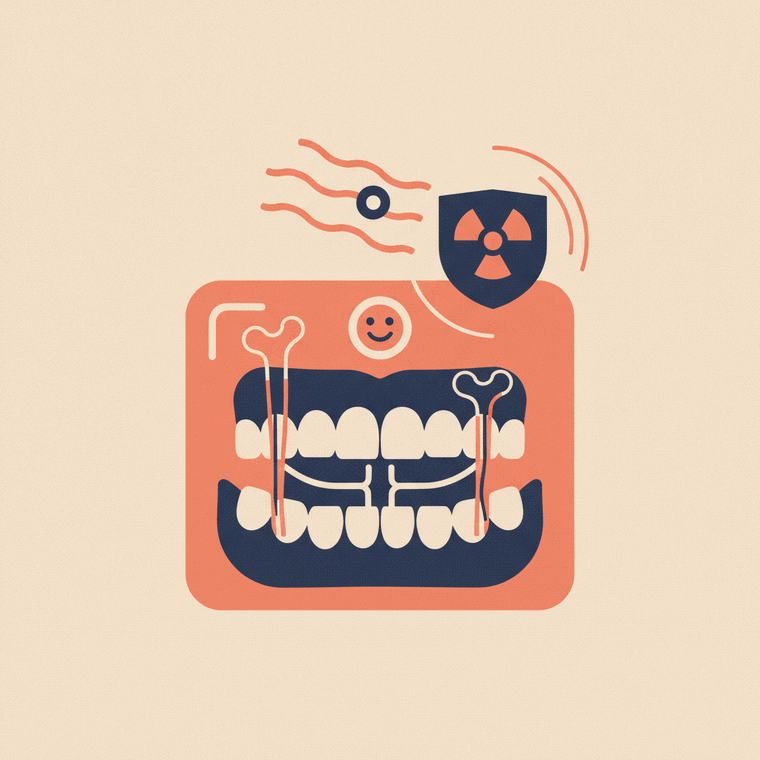
Dental X-rays use a very small dose of radiation — among the lowest in all of medical imaging — to check the teeth, roots and jaw for things a dentist can't see by looking: decay between teeth, infection at the root, bone loss, and impacted teeth. The area scanned is tiny, the beam is tightly focused, and there are no short-term effects. They're considered very safe; tell your dentist if you could be pregnant.
Key takeaways
- Dental X-rays check teeth, roots and jaw for hidden problems.
- The dose is among the lowest in all medical imaging.
- They reveal decay between teeth, root infection, bone loss and impacted teeth.
- Tell your dentist if you are, or might be, pregnant.
Dental X-rays let your dentist see what’s hidden inside and between your teeth, and in the jaw — the parts a visual check simply can’t reach.
What they show
A quick look in the mouth misses a lot. Dental X-rays reveal:
- Decay between teeth or under existing fillings
- Infection at the root of a tooth, and cysts or abscesses
- The bone supporting the teeth (important for gum disease)
- Impacted teeth, such as wisdom teeth, and the position of teeth that haven’t come through
- Problems with the jaw
A small bitewing X-ray checks a few teeth; a panoramic (OPG) X-ray gives a single broad view of the whole jaw.
How much radiation?
This is the reassuring part: dental X-rays use one of the lowest doses in all of medical imaging.[1] The area scanned is tiny, the beam is tightly focused, and there are no short-term effects at these dose levels.[2] The benefit of catching decay or infection early easily outweighs the very small risk.
Precautions
Even though the dose is so low, the usual principles apply: only the area needed is X-rayed, and shielding may be used. If you are, or might be, pregnant, tell your dentist — dental X-rays are far from the abdomen and very low dose, but unnecessary X-rays are still deferred where possible.[1]
Frequently asked questions
Are dental X-rays safe?
Yes — they use one of the lowest radiation doses in medical imaging, with no short-term effects, and the benefit of catching problems early outweighs the tiny risk.[2]
How often should I have dental X-rays?
There’s no fixed schedule — your dentist decides based on your age, risk of decay and dental history, taking only the X-rays that are genuinely needed. If you’re unsure, ask why an X-ray is being recommended.[1]
Can I have dental X-rays while pregnant?
Tell your dentist if you could be pregnant. The dose is very low and far from the abdomen, but non-urgent X-rays are generally deferred where possible.[1]
Sources
- RANZCR / InsideRadiology — Radiation risk of medical imaging — www.insideradiology.com.au/radiation-risk/
- ARPANSA — Radiation in dentistry / medical imaging doses — www.arpansa.gov.au/understanding-radiation/radiation-sources/more-radiation-sources/medical-imaging
- RadiologyInfo.org (RSNA & ACR) — X-ray (Radiography) — www.radiologyinfo.org/en/info/xray