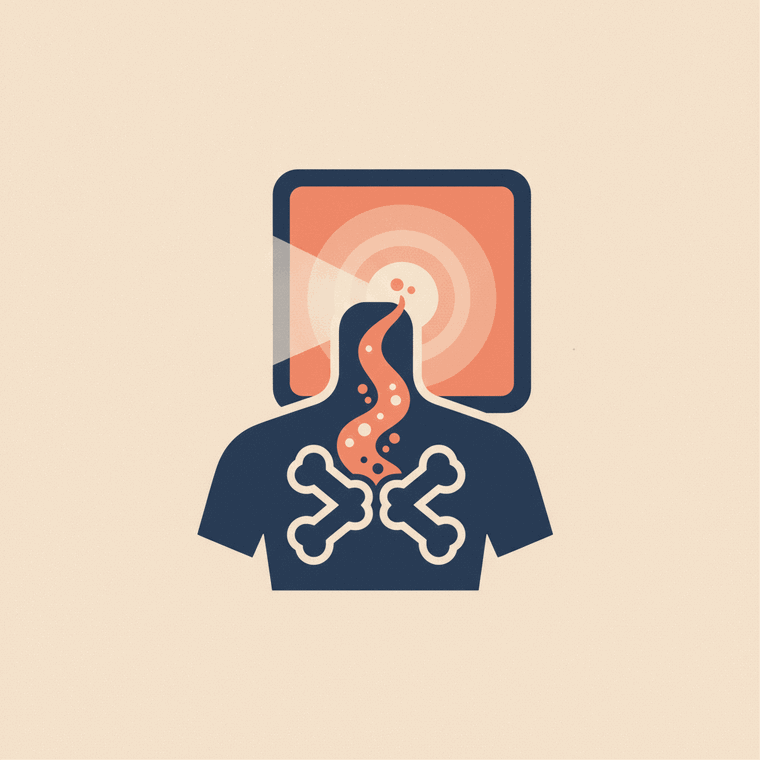
A barium swallow uses a contrast drink and real-time X-ray (fluoroscopy) to watch food and liquid move through your throat and oesophagus as you swallow. It's used to investigate swallowing difficulty, a feeling of food sticking, or reflux. You drink a chalky contrast while the radiologist watches on a screen; afterwards, drink plenty of fluids. It involves a modest radiation dose, and barium can make your stools pale for a day or two — which is normal.
Key takeaways
- A barium swallow watches the act of swallowing in real time.
- You drink a contrast that outlines the throat and oesophagus.
- It's used for swallowing difficulty, food 'sticking', and reflux.
- Drink plenty of fluids afterwards; pale stools for a day or two are normal.
Most X-rays capture a single frozen moment. A barium swallow is different — it lets the radiologist watch you swallow in real time, to see how food and liquid actually move.
What it is
A barium swallow combines a contrast drink with fluoroscopy — moving X-ray images shown live on a screen. As you swallow the contrast, the radiologist watches it travel down your throat and oesophagus, capturing images along the way.[2]
Why it’s done
Because it’s a moving study, it can reveal problems with the act of swallowing that a still picture would miss:[2]
- Swallowing difficulty (trouble getting food or liquid down)
- A feeling of food sticking in the throat or chest
- Reflux and some other problems of the upper digestive tract
- Narrowing, pouches or motility problems of the oesophagus
What to expect
You’ll drink a contrast — often a chalky barium liquid, sometimes an iodine-based drink — while standing or lying against the X-ray table, as the radiologist watches on a screen and takes images.[1] It isn’t painful. You may be asked to swallow at particular moments, or to change position.
Afterwards, drink plenty of fluids to help clear the contrast. Barium can make your stools pale for a day or two, which is completely normal.[1]
Preparation and radiation
You’ll usually be asked to fast for a few hours beforehand so your upper digestive tract is empty. A barium swallow uses fluoroscopy, so it does involve radiation — the dose for a routine study is modest, and the team uses only what’s needed.[3] Tell staff if you are, or might be, pregnant.
Frequently asked questions
What does the barium drink taste like?
It’s usually a chalky, slightly thick liquid — distinctive but not unpleasant. You’ll swallow it at certain moments while the images are taken.[1]
Why are my stools pale afterwards?
Barium passes through your gut and can make stools pale for a day or two — that’s normal. Drinking plenty of fluids helps clear it.[1]
Is a barium swallow the same as an endoscopy?
No. A barium swallow watches swallowing from the outside using X-ray; an endoscopy uses a camera passed into the throat to look directly and take samples. Your doctor chooses based on what needs to be assessed.[2]
Sources
- RANZCR / InsideRadiology — Iodine-containing contrast medium (ICCM) — www.insideradiology.com.au/iodine-containing-contrast-medium/
- RadiologyInfo.org (RSNA & ACR) — Upper GI tract X-ray (radiography) — www.radiologyinfo.org/en/info/upper-gi
- RANZCR / InsideRadiology — Radiation risk of medical imaging — www.insideradiology.com.au/radiation-risk/