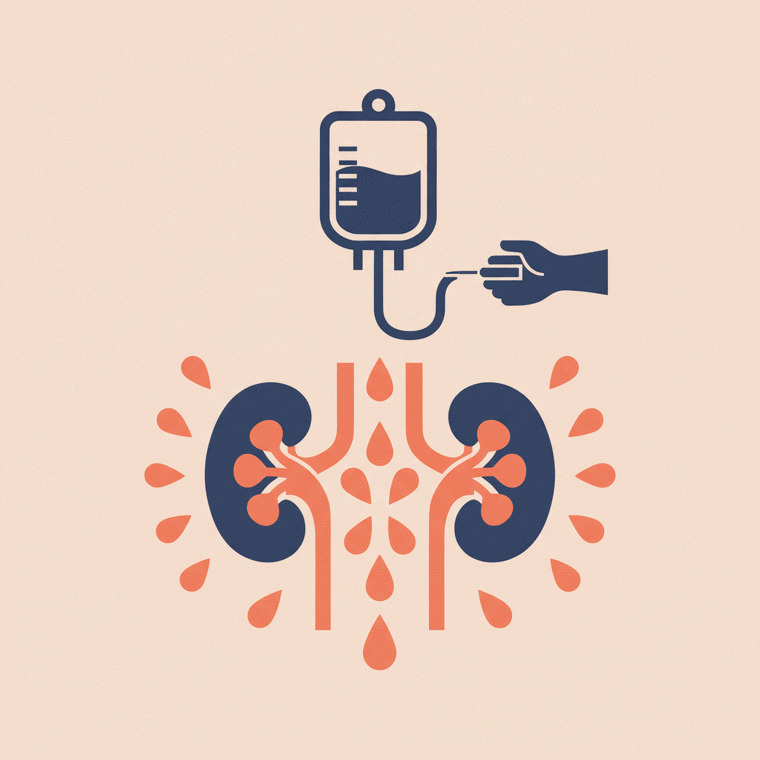
For people with normal kidneys, contrast dye is quite safe. If your kidney function is reduced, extra care is needed: a large amount of injected iodine contrast can occasionally worsen kidney function, and gadolinium carries a small risk of a condition called NSF in severe kidney disease. If you have kidney disease, diabetes or take metformin, you'll usually need a recent kidney blood test (eGFR) before a contrast scan.
Key takeaways
- With normal kidneys, contrast is quite safe.
- Large amounts of injected iodine contrast can occasionally worsen reduced kidney function.
- Gadolinium carries a small NSF risk in significant kidney impairment.
- Kidney disease, diabetes or metformin usually means a blood test before contrast.
For most people, contrast dye is safe for the kidneys. The picture changes only if your kidney function is reduced — and it’s different for the two types of contrast.[1]
Iodine contrast (CT) and your kidneys
If your kidneys work normally, iodine contrast is quite safe.[2] If your kidney function is severely reduced and you’re given a large amount into a vein or artery (for example during a heart angiogram), there’s a risk of temporarily worsening kidney function — and, rarely, a longer-lasting reduction, usually in people with already severe impairment.[1]
Small amounts (such as for a joint injection) and contrast you drink have little or no effect on the kidneys.[2] It’s also worth knowing the balance often falls the other way: a contrast scan may be the safest way to get a vital diagnosis, so the benefit frequently outweighs the small kidney risk — a judgement your team makes with you.[1]
Gadolinium (MRI) and your kidneys
With gadolinium, the concern is different: in people with significant kidney impairment, it carries a small risk of a rare condition called nephrogenic systemic fibrosis (NSF). So your kidney function is checked first, and gadolinium may be avoided or a safer agent chosen.[3]
Diabetes and metformin
If you have kidney disease, diabetes, or take metformin, bring your most recent kidney-function blood test (eGFR) when you book a contrast scan; the clinic may want it checked again closer to the appointment.[2] If your kidney function is poor, you may be given extra fluids around the scan, and may need to pause metformin after an injected-contrast scan until a repeat test is normal.[2]
Frequently asked questions
I have kidney problems — can I still have contrast?
Often yes, with care. Your team checks your kidney function and decides what’s safest — sometimes avoiding contrast, reducing the amount, giving extra fluids, or choosing a different test.[1]
Why do I need to stop metformin after a contrast CT?
Only if your kidney function is poor. It’s a precaution while your kidneys clear the contrast; you restart once a repeat blood test is normal.[2]
What is an eGFR?
It’s a number from a routine blood test that estimates how well your kidneys are filtering. Clinics use it to decide whether injected contrast is safe and how much to give.[2]
Sources
- RadiologyInfo.org (RSNA & ACR) — Contrast Materials — www.radiologyinfo.org/en/info/safety-contrast
- RANZCR / InsideRadiology — Iodine-containing contrast medium (ICCM) — www.insideradiology.com.au/iodine-containing-contrast-medium/
- RANZCR / InsideRadiology — Magnetic resonance imaging (MRI) — www.insideradiology.com.au/mri-hp/