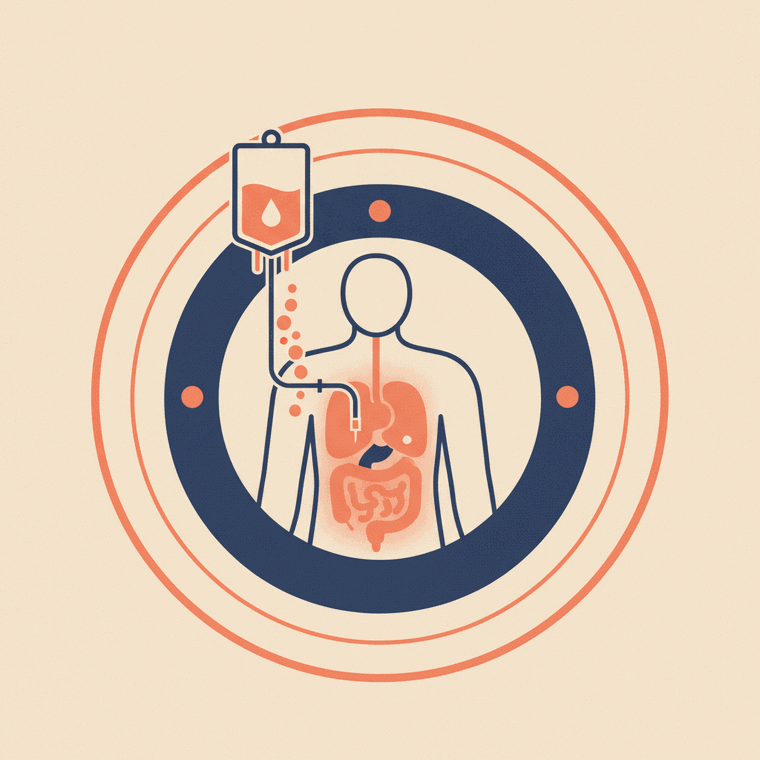
Iodine contrast (ICCM) is a dye used in CT, angiograms and some X-rays to make organs and blood vessels show up clearly — it doesn't itself produce radiation. It's very safe for most people: mild reactions (a flush or brief nausea) occur in about 1–3 in 100, while serious reactions are rare (moderate fewer than 1 in 3,000, severe fewer than 1 in 25,000). Tell staff about any asthma, allergies, kidney problems or a previous reaction. A seafood allergy is not a reason to avoid it.
Key takeaways
- Iodine contrast is a dye for CT and X-ray imaging — it doesn't produce radiation itself.
- Mild reactions (flush, brief nausea) occur in about 1–3 in 100 and settle within minutes.
- Serious reactions are rare, and staff are always equipped to treat them.
- Tell staff about asthma, allergies, reduced kidney function, diabetes/metformin, or any past reaction.
Iodine-containing contrast medium (ICCM) — often just called “contrast” or “dye” — is a chemical used in X-ray and CT imaging. Given by injection or as a drink, it makes blood vessels and organs show up clearly. Importantly, it does not produce radiation itself; it’s a substance that interacts with the X-rays.[1] It’s used routinely in many CT scans, and is essential for tests like angiograms (X-rays of blood vessels).
What the injection feels like
When iodine contrast is injected for a CT or angiogram, most people notice a warm feeling spreading through the body for about 20 seconds, often around the groin — it can feel like you’re passing urine even though you aren’t. This is very common, completely normal, and passes within 10–20 seconds, sometimes with a brief metallic taste.[1][2] Some people feel briefly nauseous; actually vomiting is uncommon. If you drink the contrast instead, you generally won’t feel any of this. The dye then leaves your body in your urine over the following hours, so you’ll be encouraged to drink plenty of fluids.
How common are reactions?
For most people iodine contrast is very safe, but reactions can happen and are unpredictable — even if you’ve had it before without trouble. Here are the real numbers:[1]
- Mild reactions (facial flushing, nausea, mild itch, sneezing): about 1–3 in every 100. These usually need no treatment and settle in minutes.
- Moderate reactions (severe vomiting, a rash, swelling of the face or throat): fewer than 1 in 3,000. These are treated promptly and watched for a few hours.
- Severe reactions (very low blood pressure, breathing difficulty): fewer than 1 in 25,000.
- Death from a severe reaction is very rare — fewer than 1 in 170,000.
A small number of people develop a delayed rash hours to days after the scan; most are mild.[2] Every radiology department is equipped at all times to treat reactions, which respond well to emergency medication in almost all cases.[1]
You’re at higher risk if you’ve reacted to contrast before, or if you have asthma or other allergies (to foods, medications, pollen and so on). If you’ve had a previous reaction, the team may use a different test, or give you corticosteroid tablets for several hours beforehand to reduce the chance of another reaction.[1]
The seafood-allergy myth
A common worry is that an allergy to seafood or shellfish means you can’t have iodine contrast. This is a myth — the iodine in seafood isn’t the cause of seafood allergy, and a seafood allergy doesn’t specifically raise your risk from contrast. What matters is a previous contrast reaction, asthma, or other significant allergies.[1]
Kidneys, diabetes and metformin
For people with normal kidneys, iodine contrast is quite safe. If your kidney function is severely reduced and you’re given a large amount into a vein or artery (for example during a heart angiogram), there’s a risk of temporarily — and rarely, lastingly — worsening kidney function.[1] Small amounts (such as for a joint injection) and contrast you drink have little or no effect on the kidneys.
If you have diabetes, kidney disease, or take metformin, bring your most recent kidney-function blood test when you book. If your kidney function is poor, you may be given extra fluids, and may need to pause metformin after the scan until a repeat test is normal.[1]
Pregnancy and breastfeeding
Any medication in pregnancy is considered carefully. There’s no known significant risk to the baby from iodinated contrast, though there’s a small theoretical chance it can affect the newborn’s thyroid — which is one reason all babies born in Australia and New Zealand have routine newborn thyroid screening anyway.[1]
If you’re breastfeeding, you do not need to stop or discard your milk — less than a thousandth of the dose passes into breast milk, and it won’t harm your baby.[1][2]
Frequently asked questions
Can I have contrast if I reacted to it before?
Tell the radiology facility when you book. People who’ve reacted before are more likely to react again, so the radiologist may choose a test that doesn’t need contrast, or give you corticosteroid tablets beforehand to reduce the risk.[1]
Does my seafood allergy mean I can’t have iodine contrast?
No. That’s a longstanding myth. The relevant risks are a previous contrast reaction, asthma, or other significant allergies — not seafood.[1]
I’m breastfeeding — do I need to stop after contrast?
No. Less than a thousandth of the dose passes into your milk, so there’s no need to stop breastfeeding or discard milk.[1]
Sources
- RANZCR / InsideRadiology — Iodine-containing contrast medium (ICCM) (Goergen) — www.insideradiology.com.au/iodine-containing-contrast-medium/
- RadiologyInfo.org (RSNA & ACR) — Contrast Materials — www.radiologyinfo.org/en/info/safety-contrast