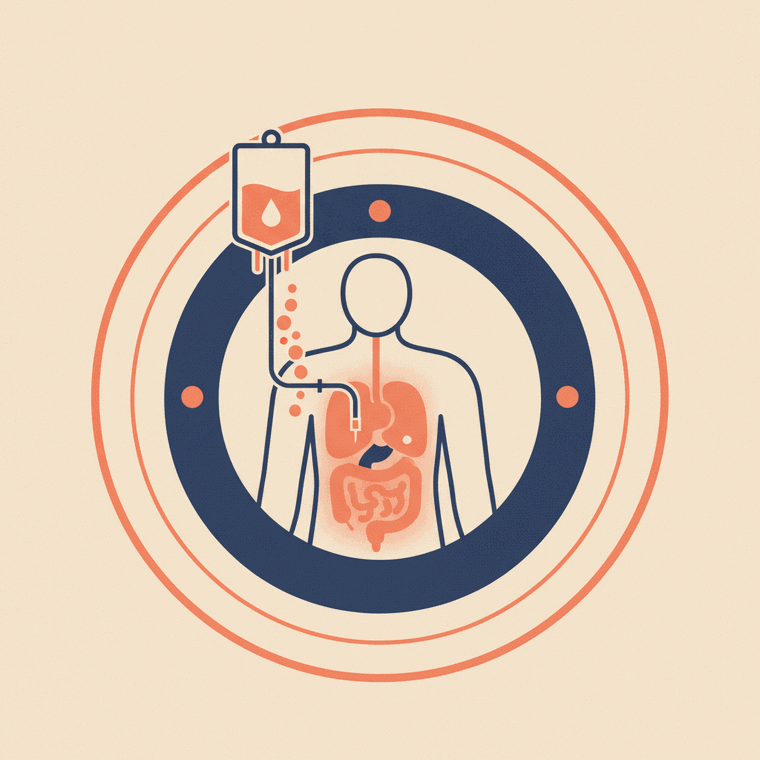
Many CT scans use an iodine contrast injection to make blood vessels and organs show up clearly. When it goes in, most people feel a brief warm flush and metallic taste that passes in seconds. It's very safe for most people — tell staff about any allergies, asthma, kidney problems, diabetes/metformin, or a previous reaction beforehand. Not all CTs need contrast; brain, spine and bone scans often use none.
Key takeaways
- Iodine contrast highlights blood vessels and organs on a CT.
- A brief warm flush and metallic taste during the injection are normal.
- It's very safe for most people; serious reactions are rare.
- Declare allergies, asthma, kidney problems and metformin beforehand.
A lot of CT scans use an iodine contrast injection. It’s added when it will help — making blood vessels and organs stand out so the radiologist can answer your doctor’s question.[2] Some CTs (such as brain, sinus, spine or bone scans) often need none. You may also be given an iodine or barium drink for scans of the gut.[1]
What the injection feels like
A small cannula is placed in a vein, and the contrast is given during the scan — often through a small pump.[2] When it goes in, most people feel a warm sensation spreading through the body for about 20 seconds, sometimes around the groin (it can feel like you’re passing urine, but you aren’t), along with a brief metallic taste.[1] This is completely normal and passes in seconds. Some people feel briefly nauseous.
Is it safe?
For most people, yes. Reactions are uncommon and usually mild — about 1–3 in 100 are mild, and serious reactions are rare.[3] Because reactions can’t be predicted, tell staff about any allergies, asthma, a previous reaction, kidney problems, diabetes or metformin, and whether you could be pregnant.[3] The dye leaves your body in your urine over the following hours, so drink plenty of fluids afterwards.
Kidneys, metformin and diabetes
If your kidney function is reduced, a large iodine dose can occasionally strain the kidneys, so clinics often check a recent kidney blood test (eGFR) first.[3] If you take metformin for diabetes, you may be advised about it around the scan — follow your clinic’s instructions.
Frequently asked questions
Why do I need contrast for my CT?
Because, for your scan, it makes blood vessels or organs show up clearly enough to answer the clinical question. Not all CTs need it.[2]
Is the warm feeling during the injection normal?
Yes — a warm flush and metallic taste are very common and pass within seconds.[1]
Does the contrast make my CT give more radiation?
No — iodine contrast itself is not radioactive and doesn’t add radiation. The radiation comes from the CT’s X-rays, whether or not contrast is used.[1]
Sources
- RadiologyInfo.org (RSNA & ACR) — Contrast Materials — www.radiologyinfo.org/en/info/safety-contrast
- RANZCR / InsideRadiology — Computed tomography (CT) — www.insideradiology.com.au/computed-tomography/
- RANZCR / InsideRadiology — Iodine-containing contrast medium (ICCM) — www.insideradiology.com.au/iodine-containing-contrast-medium/