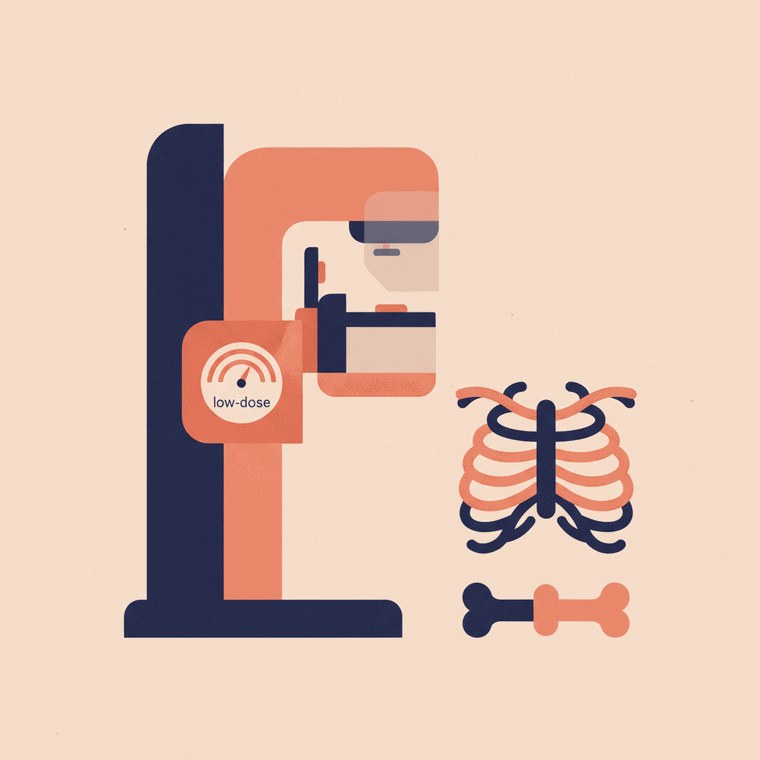
A mammogram uses a low dose of radiation (around 0.3 mSv, a few weeks of natural background), and for the screening-age group the benefit of finding cancer early outweighs the small risk. The brief compression of the breast can be uncomfortable but isn't harmful — it's needed to spread the tissue, lower the dose and get a clear image. Tell staff if you could be pregnant.
Key takeaways
- A mammogram uses a low dose of radiation (~0.3 mSv).
- For the screening-age group, early-detection benefit outweighs the small risk.
- Compression is uncomfortable but not harmful — it improves the image and lowers dose.
- Tell staff if you are, or might be, pregnant.
Mammograms are a safe, well-established test — but two things often worry people: the radiation and the compression. Here’s the honest picture of each.
The radiation
A mammogram uses a low dose of radiation — around 0.3 mSv, roughly a few weeks of natural background radiation.[1] For women in the screening age group, the benefit of finding breast cancer early is considered to outweigh the small radiation risk — the basis of the national screening program.[2] Modern equipment is designed to use as little radiation as possible while still producing a clear image, and no radiation stays in your body afterwards.[1]
The compression
During a mammogram, the breast is briefly compressed between two plates. This can be uncomfortable, but it isn’t harmful, and it’s important: it spreads the breast tissue so abnormalities are easier to see, lowers the radiation dose needed, and reduces blurring from movement.[3] The compression lasts only seconds per image, and staff can ease it if it’s painful. Booking when your breasts are least tender makes it easier.
Pregnancy
As with any X-ray, tell staff if you are, or might be, pregnant, so they can confirm the test is appropriate.[3]
Frequently asked questions
Does the radiation from a mammogram cause cancer?
The dose is low (~0.3 mSv), and for the screening-age group the benefit of early detection outweighs the very small risk. That trade-off underpins the national screening program.[2]
Is the compression bad for my breasts?
No — it’s uncomfortable but not harmful. It spreads the tissue for a clearer image and lets a lower radiation dose be used, and only lasts seconds. Tell staff if it hurts and they can reduce it.[3]
Sources
- RadiologyInfo.org (RSNA & ACR) — Radiation Dose / Mammography — www.radiologyinfo.org/en/info/safety-xray
- Cancer Council Australia — Breast cancer screening — www.cancer.org.au/cancer-information/screening-tests-and-treatments/early-detection-and-screening/breast-cancer-screening
- RANZCR / InsideRadiology — Radiation risk of medical imaging — www.insideradiology.com.au/radiation-risk/