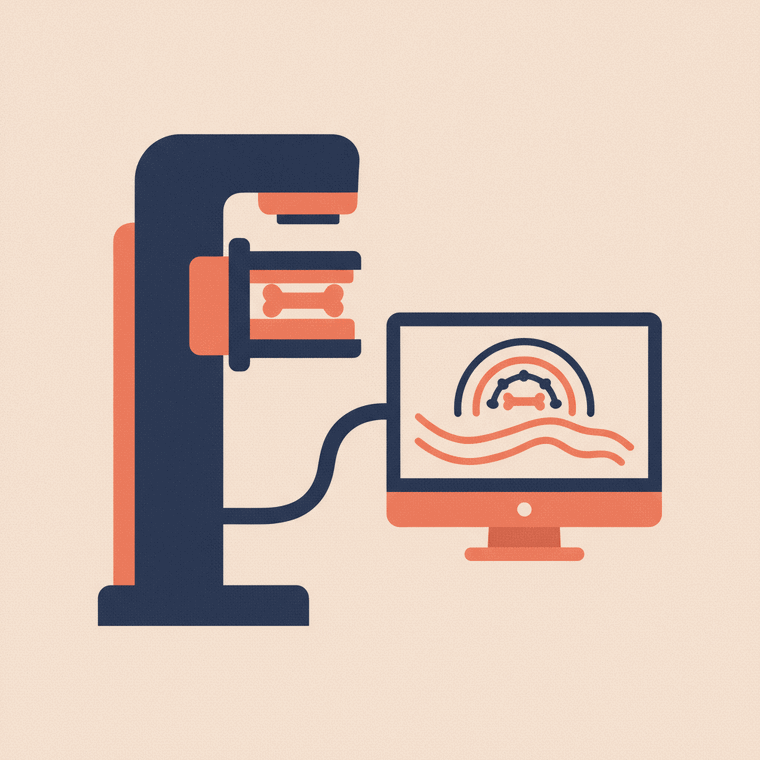
A digital mammogram captures the image electronically rather than on X-ray film. This lets the radiologist adjust brightness and contrast and zoom in, makes images easy to store and compare with previous scans, can allow a slightly lower dose, and underpins newer techniques like 3D mammography. For you, the experience is the same as any mammogram — the difference is in how the image is captured and viewed.
Key takeaways
- A digital mammogram captures the image electronically, not on film.
- Radiologists can adjust and zoom the image for a clearer read.
- Digital images are easy to store and compare over time.
- The experience is the same as any mammogram.
Almost all mammograms today are digital. The difference from older film mammography isn’t in what you experience — it’s in how the image is captured and viewed.[2]
Film vs digital
A traditional mammogram recorded the image on X-ray film, like a photograph. Full-field digital mammography (FFDM) captures it electronically — much like a digital camera — so it appears on a high-resolution screen.[1] This brings several practical advantages:
- The radiologist can adjust brightness and contrast and zoom in on an area, which can make a clearer read.
- Images are easy to store and share, and quick to compare with your previous mammograms to spot change.
- The efficiency of digital capture can allow better pictures at a lower dose.[1]
- Digital capture underpins newer techniques like 3D mammography (tomosynthesis) and computer-aided detection.
What it means for you
For you, a digital mammogram is exactly the same experience as any mammogram — the breast is positioned and briefly compressed, and images are taken in moments. The “digital” part happens behind the scenes.
Frequently asked questions
Is a digital mammogram different to have?
No — the experience is the same. The difference is that the image is captured electronically and viewed on a screen, rather than on film.[2]
Does digital mean less radiation?
The dose for a mammogram is low either way, and digital can allow a slightly lower dose. Its main advantages are in image handling — adjusting, zooming, storing and comparing — and enabling newer techniques like 3D mammography.[1]
Sources
- RadiologyInfo.org (RSNA & ACR) — Mammography (digital) — www.radiologyinfo.org/en/info/mammo
- healthdirect — Mammography — www.healthdirect.gov.au/mammography