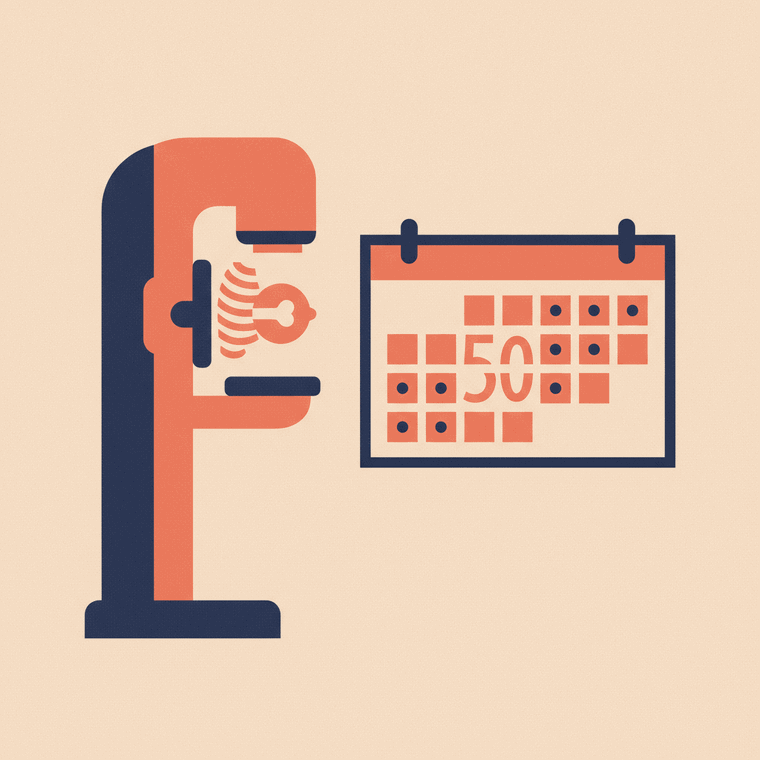
In Australia, BreastScreen offers a free mammogram every two years and actively invites women aged 50–74 (those 40–49 and 75+ can attend free too). It works: for every 1,000 women screened two-yearly from 50 to 74, an estimated 8 breast-cancer deaths are prevented. But screening also has downsides — mainly false alarms and overdiagnosis (about 8 per 1,000 women have a cancer found that would never have harmed them). Knowing both sides helps you make an informed choice.
Key takeaways
- BreastScreen invites women 50–74 for a free mammogram every two years; 40–49 and 75+ can attend free without an invitation.
- Benefit: about 8 breast-cancer deaths prevented per 1,000 women screened two-yearly from 50 to 74.
- Harms: false alarms and anxiety, and overdiagnosis (~8 per 1,000) — treating a cancer that would never have caused harm.
- The radiation dose is tiny — roughly 18 weeks of natural background radiation.
Breast cancer is the most common cancer diagnosed in Australian women and the second leading cause of cancer death in women.[1] Finding it early — before it can be felt — is the whole point of screening, and in Australia that’s done through a free national program. But good health information doesn’t just tell you screening is a good idea; it tells you the benefits and the downsides so you can decide with your eyes open. Here’s both.
How BreastScreen works
BreastScreen Australia is the national program, and it’s free. It actively invites women aged 50–74 to have a mammogram every two years, because that’s the group where the evidence for benefit is strongest.[1][2] Two things many people don’t realise:
- Women aged 40–49 and 75 and over are also eligible to attend free — they just don’t get a personal invitation.[1]
- You don’t need a doctor’s referral. You can book yourself directly at one of 600+ clinics nationwide by calling 13 20 50.[1]
A screening mammogram is a low-dose X-ray of the breast. The dose is genuinely small — Cancer Council puts it at roughly the same as 18 weeks of the natural background radiation we’re all exposed to anyway, and machines use the lowest dose that still gives a clear image.[1]
The benefit: fewer deaths
This is the reason the program exists. Australian and international evidence shows that women who take part in organised two-yearly screening have substantially lower breast-cancer mortality.[6] Put as a concrete number: for every 1,000 women screened every two years from age 50 to 74, about 8 breast-cancer deaths are prevented.[6]
Early detection also tends to mean less intensive treatment if cancer is found — smaller operations, less aggressive therapy — and it can pick up pre-invasive changes (DCIS) before they ever become invasive.[6]
The harms: false alarms and overdiagnosis
Screening a healthy population always has a cost, and being honest about it is part of respecting your choice.
False alarms. Screening sometimes flags something that turns out not to be cancer. That means a call-back for more views, an ultrasound, or occasionally a biopsy — and the anxiety that comes with it. Most call-backs are not cancer, but the worry is real, and for some women it lingers.[1]
Overdiagnosis. This is the subtler harm. Some cancers found by screening would never have caused symptoms or harm in a woman’s lifetime — but because we can’t yet tell which ones, they get treated anyway. The best current estimate: for every 1,000 women screened two-yearly from 50 to 74, about 8 are overdiagnosed — roughly the same order of magnitude as the number of deaths prevented.[6] That’s not a reason to avoid screening, but it’s why the decision is a genuine trade-off rather than a no-brainer, and why Cancer Council frames its recommendation as: screen, having considered the benefits and the downsides.[1]
Weighing it up
Put simply, screening from 50 to 74 prevents roughly as many deaths as it causes overdiagnoses per 1,000 women — but a prevented death and an overdiagnosis are not equal in weight, which is why expert bodies still recommend screening for the invited age group while being upfront about the harms.[1][6] For most women aged 50–74, the balance favours taking part. If you’re unsure, or you’re in the 40–49 group deciding whether to start early, talk it through with your GP.
(Australia’s screening program is periodically reviewed, and the eligible age range and technology are kept under review as new evidence emerges — your BreastScreen service will always have the current details.)
Screening is for people without symptoms
One crucial distinction: screening is for women who feel well and have no breast symptoms. If you notice a change — a lump, a change in shape or skin, nipple changes, or pain — don’t wait for a screening appointment. See your doctor, who will arrange the right tests (which may be a diagnostic mammogram and ultrasound rather than a screening one).[4]
What to expect on the day
A BreastScreen visit is quick. A female radiographer positions each breast on the machine and applies brief compression — uncomfortable but over in seconds, and important because it spreads the tissue, lowers the dose and sharpens the image.[5] A tip that saves an unnecessary call-back: skip deodorant, talc and perfume on the day, as their particles can mimic abnormalities on the image.[4] Your results are sent to you (and, if you nominate one, your GP), usually within a couple of weeks.
Frequently asked questions
Does breast screening actually save lives?
Yes. The evidence shows organised two-yearly screening lowers breast-cancer deaths — about 8 deaths prevented per 1,000 women screened from 50 to 74.[6]
What are the downsides I should know about?
Mainly false alarms (call-backs that turn out not to be cancer, with the anxiety that brings) and overdiagnosis (finding and treating a cancer that would never have harmed you) — estimated at about 8 per 1,000 screened. The radiation dose is very small.[1][6]
Do I need a referral, and what does it cost?
No referral, and it’s free through BreastScreen. Book directly on 13 20 50.[1]
I’m under 50 — should I screen?
Women 40–49 can attend BreastScreen free but aren’t sent invitations. Whether to start early is worth discussing with your GP, particularly if you have a family history — and any new breast change should be checked by a doctor regardless of age.[1]
This article discusses cancer screening and the trade-offs involved. It’s general information, not personal medical advice — if you’re weighing up screening or worried about a breast change, your GP can help you decide what’s right for you.
Sources
- Cancer Council Australia — Breast screening — www.cancer.org.au/cancer-information/screening-tests-and-treatments/early-detection-and-screening/breast-cancer-screening
- BreastScreen Australia Program — Dept of Health, Disability and Ageing — www.health.gov.au/our-work/breastscreen-australia-program
- AIHW — BreastScreen Australia monitoring report 2025 — www.aihw.gov.au/reports/cancer-screening/breastscreen-australia-monitoring-report-2025/contents/breastscreen-australia
- healthdirect — Mammography — www.healthdirect.gov.au/mammography
- RANZCR / InsideRadiology — Mammography — www.insideradiology.com.au/mammography/
- Benefits and harms of breast cancer screening — cohort study of mortality and overdiagnosis (2023) — pmc.ncbi.nlm.nih.gov/articles/PMC10524083/