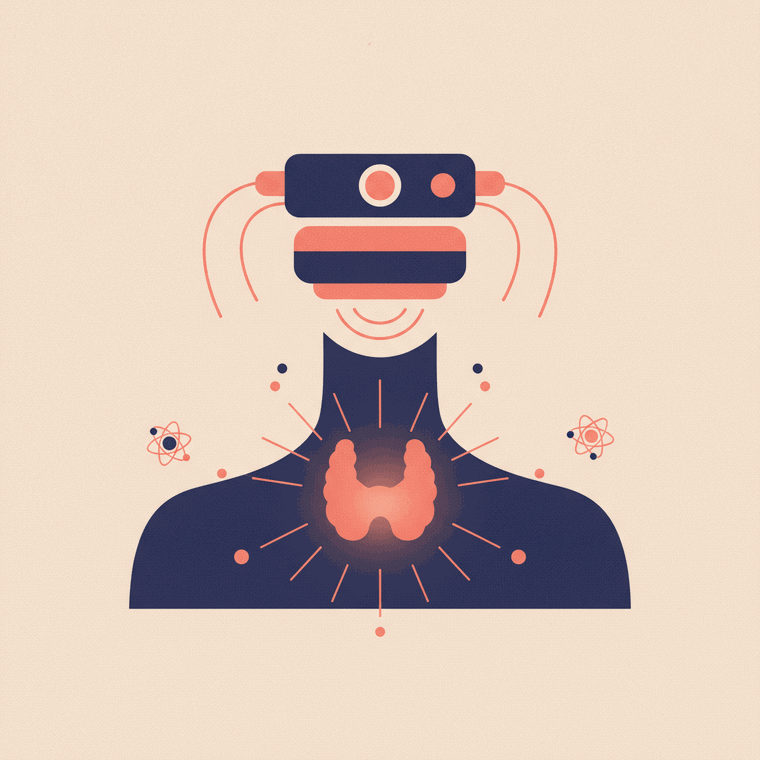
A thyroid scan is a nuclear medicine test that uses a small radioactive tracer to show how your thyroid gland is functioning — how active it is overall, and whether any lumps (nodules) are over- or under-active. It's commonly used for an overactive thyroid or to assess nodules. It's different from a thyroid ultrasound, which shows the gland's structure. The dose is small, and the scan is painless.
Key takeaways
- A thyroid scan shows how the thyroid gland is functioning.
- It's used for an overactive thyroid and to assess nodules.
- It can show whether a nodule is over- ('hot') or under-active ('cold').
- It's different from a thyroid ultrasound, which shows structure.
A thyroid scan is a nuclear medicine test that examines how your thyroid gland — the butterfly-shaped gland in your neck — is working.[1] Because the thyroid naturally takes up iodine, a tracer based on iodine (or technetium) concentrates there and reveals the gland’s function.
What it’s used for
A thyroid scan helps to:[1]
- Measure thyroid function — how active the gland is overall
- Assess an overactive thyroid (hyperthyroidism) and find the cause
- Evaluate nodules (lumps) — showing whether a nodule is over-active (“hot”) or under-active (“cold”), which guides what happens next
- Look at the gland’s overall size and activity
It complements blood tests and a thyroid ultrasound — which shows the gland’s structure rather than its function. Often, more than one test is used together.[1]
What to expect
You’re given the tracer (a small capsule, drink, or injection), and after it’s taken up by the gland, a gamma camera takes pictures of your neck.[1] The scan is painless, and the radiation dose is small. Some thyroid tests have specific preparation — for example pausing certain medications or avoiding iodine-rich foods and contrast scans beforehand — so your clinic will give you instructions.
Tell the team if you are, or might be, pregnant or breastfeeding, as thyroid tracers need particular care in these situations.[1]
Frequently asked questions
What’s the difference between a thyroid scan and a thyroid ultrasound?
A nuclear medicine thyroid scan shows how the gland is working (its function); a thyroid ultrasound shows what it looks like (its structure). They give different, complementary information.[1]
What does a ‘hot’ or ‘cold’ nodule mean?
A “hot” nodule is over-active (taking up lots of tracer); a “cold” nodule is under-active. This helps guide whether and how a nodule is investigated further — your doctor explains what it means for you.[1]
Is a thyroid scan safe?
Yes — it uses a small dose of radiation, and reactions to the tracer are very rare. Tell your team if you could be pregnant or are breastfeeding.[1]
Sources
- RadiologyInfo.org (RSNA & ACR) — General Nuclear Medicine (thyroid) — www.radiologyinfo.org/en/info/gennuclear
- RANZCR / InsideRadiology — Nuclear medicine (Cain) — www.insideradiology.com.au/nuclear-medicine/