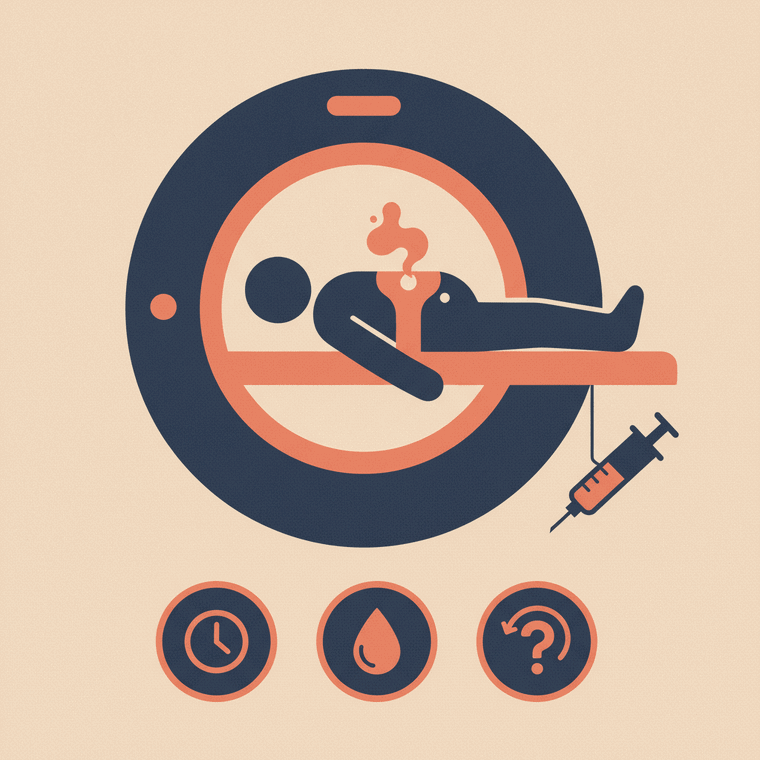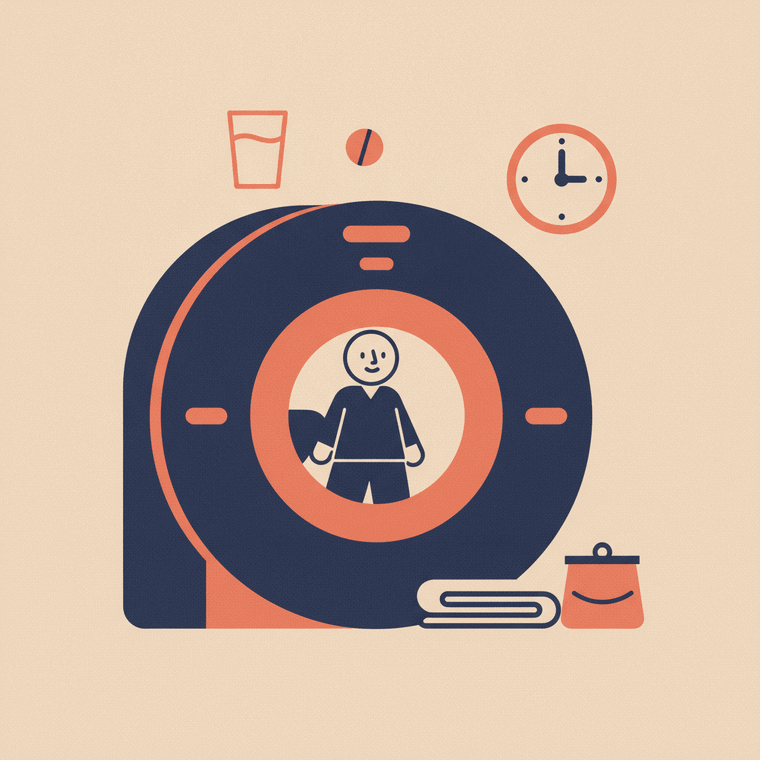
Preparation for a CT depends mainly on whether you're having contrast dye. If you are, you'll usually be asked to fast for a few hours and may need a recent kidney (blood) test, and you should tell staff about any allergies, kidney problems, diabetes medication (especially metformin) or thyroid problems. Always mention if you could be pregnant. You'll remove metal (jewellery, dentures, underwire, hearing aids) over the scan area. A plain CT with no contrast usually needs little or no preparation.
Key takeaways
- Most prep relates to contrast dye — fasting and a kidney check are common.
- Tell staff about allergies, kidney disease, diabetes (metformin) and thyroid problems.
- Always declare possible pregnancy; remove metal over the scan area.
- A plain CT (no contrast) needs little or no preparation.
How you prepare for a CT depends mostly on one thing: whether the scan uses contrast dye. Your clinic will tell you which applies — here’s what each involves.
If you’re having contrast
Many CT scans use an iodine-based contrast (a dye) to make blood vessels and organs stand out, and that’s where most of the preparation comes in:[1]
- Fasting. You’ll usually be asked not to eat for a few hours beforehand. You can generally still drink water unless told otherwise.
- A kidney check. Because the kidneys clear the dye, you may need a recent blood test to check they’re working well.[2]
- Tell staff about:
- Allergies — especially any past reaction to contrast dye. If you’ve reacted before, your doctor may prescribe medication to reduce the risk.[1]
- Kidney disease.
- Diabetes — particularly if you take metformin, which is sometimes paused around a contrast scan.[2]
- Thyroid problems and any recent illnesses or heart conditions.[1]
Some abdominal CTs also use a contrast drink to outline the bowel — you’d sip it over an hour or so before the scan.
Most contrast reactions are mild and brief (a warm flush, a metallic taste), and radiology departments are well-equipped for the rare serious ones.[1]
For any CT scan
- Declare possible pregnancy. Always tell the radiographer and your doctor if you are, or might be, pregnant — CT uses radiation, so a radiation-free test may be preferred, or the dose minimised if the scan is essential.[1]
- Remove metal over the area. Jewellery, glasses, dentures, hairpins, hearing aids, underwired bras and some piercings can all affect the images, so you’ll remove them (you may change into a gown).[1]
- A plain CT (no contrast) usually needs no fasting — follow whatever your clinic advises.
What to bring
- Your referral and Medicare card (and concession card if you have one)
- Any previous scans of the same area
- A list of your medications and allergies
- Recent blood test results if your clinic asked for them
Arrive 10–15 minutes early to complete any paperwork. Afterwards, if you had contrast, drinking plenty of water helps flush it out, and you can return to normal activities straight away.[1]
Frequently asked questions
Do I have to fast before a CT scan?
Only for some — mainly if you’re having contrast dye, when fasting for a few hours is common. A plain CT usually needs no fasting. Your clinic will tell you which applies.[1]
Why do they ask about metformin?
Metformin (a common diabetes medicine) is sometimes paused around a contrast CT as a precaution related to kidney function. Tell the team you take it, and follow their advice.[2]
What should I tell staff before a CT?
Any allergies (especially to contrast), kidney disease, diabetes medication, thyroid problems, recent illnesses, and whether you could be pregnant. These help the team plan the safest scan.[1]
Sources
- RadiologyInfo.org (RSNA & ACR) — CT of the Body — www.radiologyinfo.org/en/info/bodyct
- RANZCR / InsideRadiology — Iodine-containing contrast medium (ICCM) — www.insideradiology.com.au/iodine-containing-contrast-medium/
- healthdirect — CT scan — www.healthdirect.gov.au/ct-scan