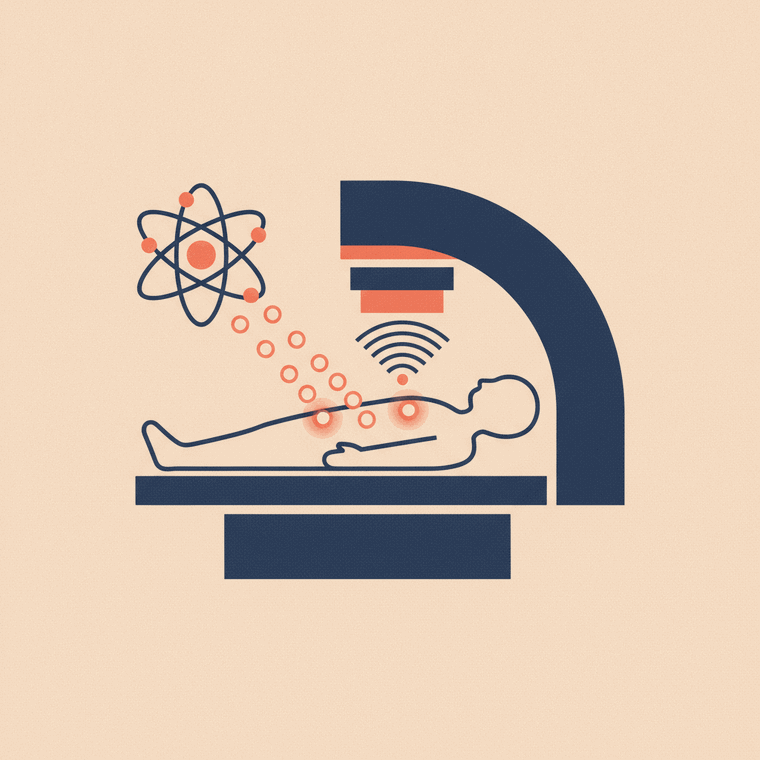
PET is one of the most valuable scans in cancer care. Because many cancers are very active, they stand out on PET — so it's used to stage a cancer (see how far it has spread), check whether treatment is working, and look for recurrence. It's usually done as a PET-CT, giving both the activity and the exact location. In Australia, Medicare funds PET-CT for a defined list of cancer indications when a specialist requests it.
Key takeaways
- Many cancers are very active and stand out on PET.
- PET helps stage cancer — showing how far it has spread.
- It's used to check whether treatment is working, and to detect recurrence.
- Medicare funds PET-CT for specified cancer indications in Australia.
PET has become one of the most useful tools in cancer care, because it shows how active tissue is — and many cancers are very metabolically active, so they stand out.[1]
How PET is used in cancer
- Staging — a whole-body PET-CT can show how far a cancer has spread, which is often decisive in choosing between surgery, radiotherapy, chemotherapy or a combination.[2]
- Checking treatment — repeating a PET can show whether a cancer is responding (becoming less active), sometimes before a tumour visibly shrinks.
- Detecting recurrence — PET can help find cancer that has come back, occasionally before it shows on other scans.
Why PET-CT
These questions need both where and how active, so PET is almost always done as a PET-CT — the PET shows activity and the CT pinpoints the exact location.[1]
In Australia
Medicare funds PET-CT for a defined and expanding list of cancer indications — such as staging certain lymphomas, lung, head and neck, oesophageal and other cancers — when requested by an appropriate specialist. Whether a scan is bulk-billed or has an out-of-pocket cost depends on the indication and the clinic, so ask when booking. For the official, current list, check MBS Online or ask your specialist.
What to weigh up
A PET-CT is a higher-dose scan (around 14 mSv), but in cancer care the information — whether and where a cancer has spread, or whether treatment is working — is usually very valuable, so the benefit generally outweighs the radiation.[1] Remember that an active spot isn’t automatically cancer; a specialist interprets the findings in context.
Frequently asked questions
Why is PET used so much in cancer?
Because many cancers are very active and take up more tracer, PET can find them, show whether they’ve spread, and reveal whether treatment is working — often adding information other scans can’t.[1]
Will Medicare cover a PET scan for my cancer?
Medicare funds PET-CT for a specified list of cancer indications when referred appropriately. Whether yours qualifies, and any cost, depends on the indication and clinic — ask your specialist or check MBS Online.[2]
Is a PET scan worth the radiation in cancer?
In cancer care the information is usually crucial — staging, response, or recurrence — so the benefit generally outweighs the dose. Your team weighs this for your situation.[1]
Sources
- RadiologyInfo.org (RSNA & ACR) — General Nuclear Medicine (PET) — www.radiologyinfo.org/en/info/gennuclear
- Cancer Council Australia — Tests for cancer — www.cancer.org.au/cancer-information/what-is-cancer/tests-for-cancer
- RANZCR / InsideRadiology — Nuclear medicine (Cain) — www.insideradiology.com.au/nuclear-medicine/