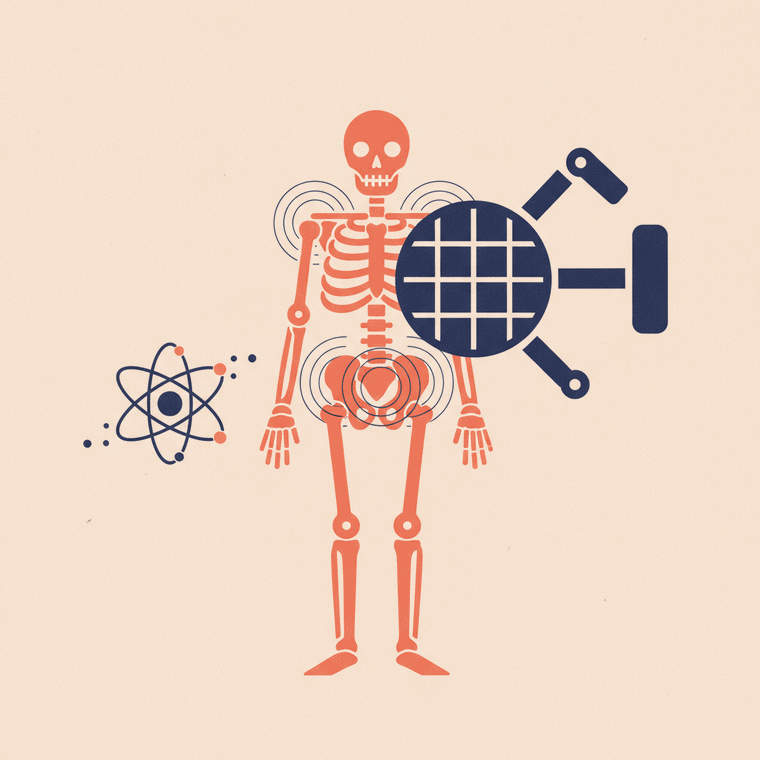
A PET-CT combines two scans in one machine: a PET (which shows how active tissues are) and a CT (which shows detailed anatomy). Done one after the other without moving, the images are merged — 'image fusion' — so a finding's activity and exact location are seen together. This is why PET-CT is now the standard way most PET scans are done, especially in cancer.
Key takeaways
- PET-CT combines a PET and a CT in a single machine.
- PET shows activity; CT shows precise anatomy.
- Merging them ('image fusion') shows what's active and exactly where.
- It's especially valuable in cancer care.
A PET-CT is a single machine that performs two scans, one after the other, without you moving in between: a PET and a CT.[1] Merging them solves a problem each has on its own.
Why combine them
- PET shows where tissue is active — a strong clue to disease — but is fuzzy about exactly where in the body that activity is.
- CT shows precise anatomy, but not activity.
Put together, the merged image — a technique called image fusion — shows the activity and its exact location at once, which makes findings far easier to interpret and localise.[1] This is why PET-CT is now the standard way most PET scans are done, especially in cancer.
What to expect
You’re given the PET tracer, rest quietly while it distributes (often about an hour), then have the combined scan — the PET and CT parts happen in the one session, usually taking 20–40 minutes of scanning.[1] You lie still on a bed that moves slowly through the ring-shaped scanner; it’s painless and not fully enclosed like an MRI.
A whole-body PET-CT is a higher-dose study (around 14 mSv), weighed against the valuable combined information.[2]
Frequently asked questions
Is PET-CT one scan or two?
Technically two — a PET and a CT — but done together in one machine and one session, then merged into a single set of images.[1]
Is a PET-CT enclosed like an MRI?
No. The PET-CT scanner is a short ring you pass through, open at both ends — most people who feel claustrophobic in an MRI manage a PET-CT comfortably.[1]
What’s newer — is there PET-MRI too?
Yes. Some centres have PET-MRI, combining PET with MRI instead of CT, which suits certain situations and lowers the CT radiation. PET-CT remains the most widely available combination.[1]
Sources
- RadiologyInfo.org (RSNA & ACR) — General Nuclear Medicine (PET-CT) — www.radiologyinfo.org/en/info/gennuclear
- RANZCR / InsideRadiology — Nuclear medicine (Cain) — www.insideradiology.com.au/nuclear-medicine/