MRI is the best scan for looking at the discs, nerves and spinal cord — but here's the part most people don't hear: for ordinary low back pain, you usually don't need one. Australian guidelines (Choosing Wisely) advise against routine spine imaging without 'red flag' features, because scans rarely change treatment and often reveal harmless age-related changes that cause needless worry and even unnecessary surgery. MRI becomes important when there are warning signs — nerve damage, trauma, a cancer history, or possible infection.
Key takeaways
- For most non-specific back pain, guidelines advise against routine imaging.
- Scans often show 'bulging discs' in people with no pain — findings that can mislead.
- MRI is clearly indicated when there are red flags (see below) or a plan for surgery.
- Red flags include leg weakness, loss of bladder/bowel control, trauma, cancer history or fever.
If your back is hurting, it feels logical to want a scan to “see what’s wrong.” But when it comes to the spine, more imaging isn’t always better — and Australian clinical guidelines are surprisingly clear about it. Here’s the honest picture.
The surprising bit: most back pain doesn’t need an MRI
For ordinary, non-specific low back pain, national guidance — including Choosing Wisely Australia — recommends against routine imaging (MRI, CT or X-ray) in the absence of warning signs.[1] That can feel counterintuitive, so here’s why:
- It rarely changes treatment. Most acute back pain settles with time, movement and simple pain relief, whether or not you’ve had a scan.[2]
- Scans over-diagnose. MRI is so sensitive that it finds “bulging discs” and wear-and-tear in most adults — including people with no pain at all. Seeing these can cause unnecessary worry, more tests, and sometimes surgery that wouldn’t have helped.[1]
In other words, an early scan for simple back pain can create problems rather than solve them. A good GP or physiotherapist managing your back conservatively isn’t being dismissive — they’re following the evidence.
When an MRI is the right call: the red flags
MRI genuinely matters when there are features suggesting something more than muscular or “mechanical” pain. Your doctor will look for red flags, including:[2][3]
- Nerve problems — significant or worsening leg weakness, numbness, or pain following a nerve path (sciatica that isn’t improving)
- Cauda equina warning signs — loss of bladder or bowel control, or numbness around the groin/saddle area (this is an emergency — seek care immediately)
- Serious cause suspected — a history of cancer, unexplained weight loss, fever or signs of infection, or intravenous drug use
- Significant trauma — a fall or accident, especially with osteoporosis
- Planned spinal surgery or injections, where MRI maps the anatomy
In these situations MRI is the best tool, because it shows the discs, nerve roots, spinal cord and soft tissues in detail, without radiation.[3]
What an MRI of the spine is like
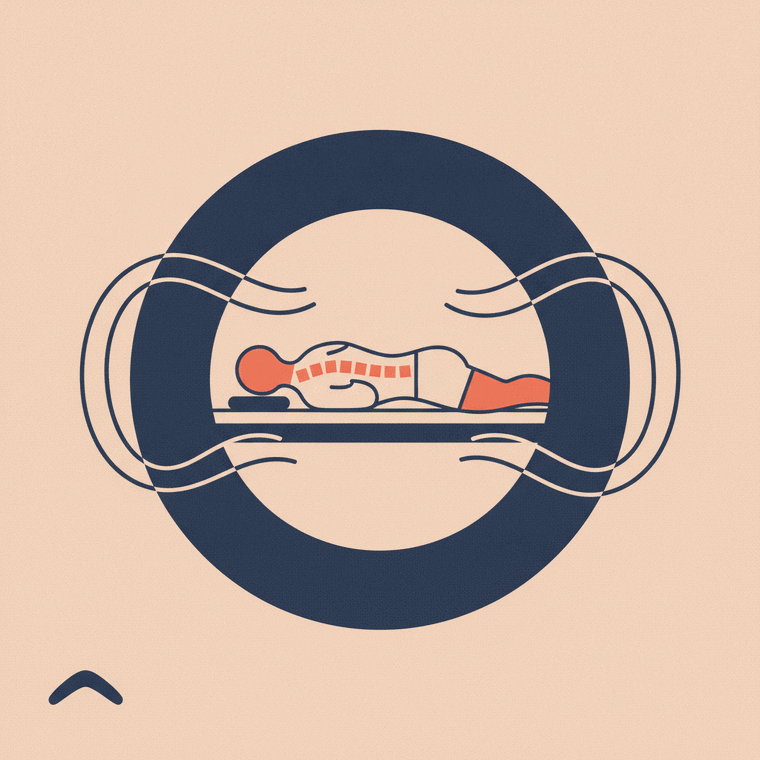
It’s the same as any MRI: you lie still on the table as it moves into the scanner, with earplugs for the noise, for around 20–40 minutes.[3] Contrast is sometimes used if infection, a tumour or previous surgery is being assessed. You’ll be screened for metal and implants first, as always.
A sensible way to think about it
If your back pain is new and there are no red flags, it’s reasonable — and evidence-based — to start with conservative care and reserve MRI for pain that doesn’t improve or that develops warning signs. If you have any of the red flags above, that’s exactly when a scan earns its place. When in doubt, your GP can help you decide, and you can always ask: “Would a scan change what we do next?”
Frequently asked questions
I’ve had back pain for a week — should I get an MRI?
Usually not. For recent, non-specific back pain without red flags, guidelines advise against routine imaging because it doesn’t improve outcomes and often finds harmless changes. Most back pain improves within a few weeks.[1]
My MRI showed a ‘bulging disc’ — does that mean I need surgery?
Not on its own. Disc bulges and degeneration are extremely common and are found in many people without any pain. What matters is whether the findings match your symptoms — your treating doctor interprets the scan in that context.[1]
What are the emergency signs I shouldn’t ignore?
Loss of bladder or bowel control, numbness around the groin, or rapidly worsening leg weakness — these can signal a serious problem (cauda equina) and need urgent medical attention, not a wait-and-see approach.[2]
Sources
- Choosing Wisely Australia — imaging for low back pain — www.choosingwisely.org.au/recommendations
- RACGP — Low back pain and imaging guidance — www.racgp.org.au/
- RANZCR / InsideRadiology — Magnetic resonance imaging (MRI) — www.insideradiology.com.au/mri-hp/
- RadiologyInfo.org (RSNA & ACR) — MRI Safety — www.radiologyinfo.org/en/info/safety-mr