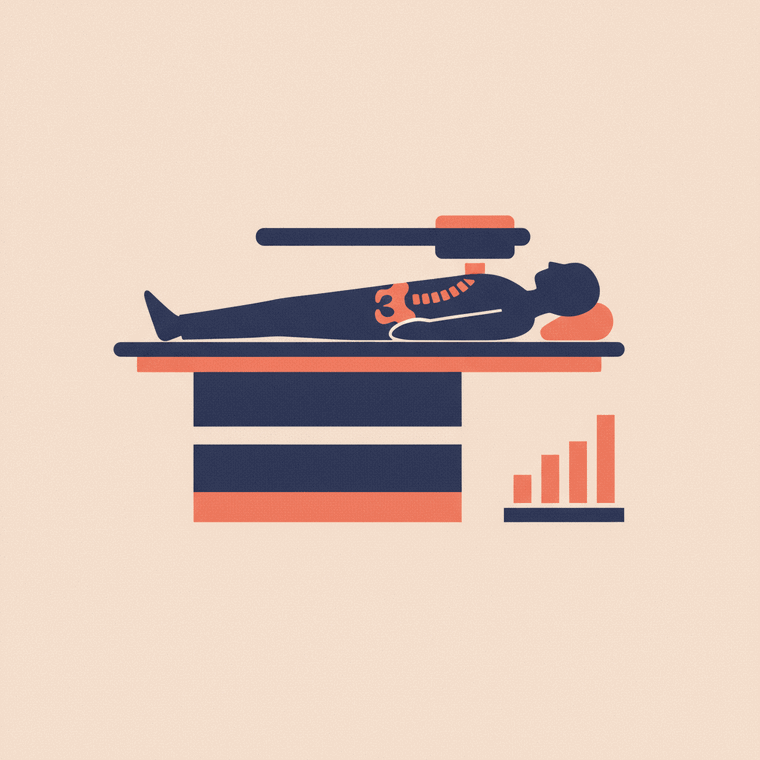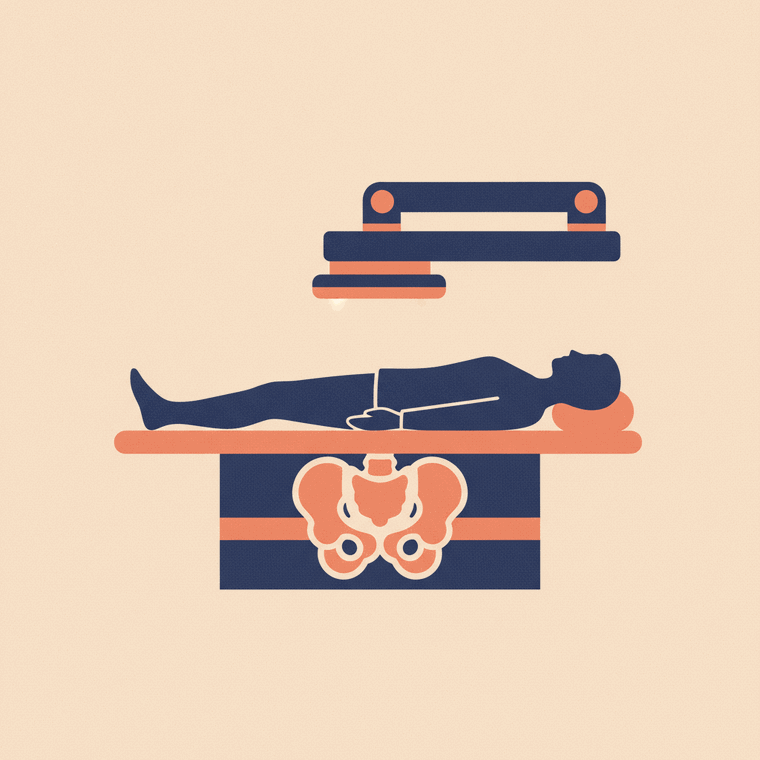
A DXA scan is quick, painless and very low-dose. You lie on a padded table while a scanning arm passes over your hip and lower spine — there's no injection and no tunnel. It takes about 10–20 minutes, and there's no aftercare. A few things can affect it: recent contrast or nuclear medicine scans, calcium supplements, and metal implants at the hip or spine.
Key takeaways
- You lie on a table while a scanning arm passes over you — painless, no injection.
- It usually scans the hip and lower spine, and takes 10–20 minutes.
- Skip calcium supplements for 24 hours; avoid it after recent contrast/tracer scans.
- Metal implants at the hip or spine mean another site is used.
A DXA (bone mineral density) scan is one of the easiest scans to have — quick, painless and low-dose.[1] Here’s what actually happens.
Before the scan
There’s very little preparation, but two things matter:[1]
- Don’t take calcium supplements for 24 hours beforehand.
- Wear loose clothing without metal (zips, belts, buttons) over the hip and spine, or you may change into a gown.
On the day
You lie on a padded table. A scanning arm passes slowly over you, usually measuring your hip and lower spine — the sites most useful for assessing fracture risk. There’s no injection and no enclosed tunnel.[1] You hold still (and briefly hold your breath) so the image isn’t blurred.
The whole thing takes about 10–20 minutes, and there’s no aftercare — you can leave straight away. Some centres add a quick Vertebral Fracture Assessment (VFA), a low-dose spine image to check for hidden spinal fractures, which adds only a few minutes.[1]
A few things that affect it
- Avoid a DXA for 10–14 days after a scan that used contrast (like a CT with dye) or a nuclear medicine tracer, as these can interfere with the result.[1]
- Metal implants like a hip replacement or spinal fusion mean that site can’t be measured, so another site (such as the forearm) is used instead.[2]
- If you’re following your bone density over time, try to have follow-up scans on the same machine, as different scanners can’t be directly compared.[1]
The result
Your bone density is reported as a T-score, which your doctor interprets (see DXA bone density scans for what the numbers mean).[2]
Frequently asked questions
Does a DXA scan hurt?
No — it’s completely painless, with no injection. You simply lie still while the scanner passes over you.[1]
How long does a DXA scan take?
About 10–20 minutes, with minimal preparation and no aftercare for a standard scan.[1]
Do I need to fast?
No — you can eat normally. Just skip calcium supplements for 24 hours beforehand.[1]
Sources
- RadiologyInfo.org (RSNA & ACR) — Bone Density Scan (DEXA/DXA) — www.radiologyinfo.org/en/info/dexa
- RANZCR / InsideRadiology — Bone mineral density scan (DXA) (Hendrich) — www.insideradiology.com.au/bone-mineral-density-scan-hp/