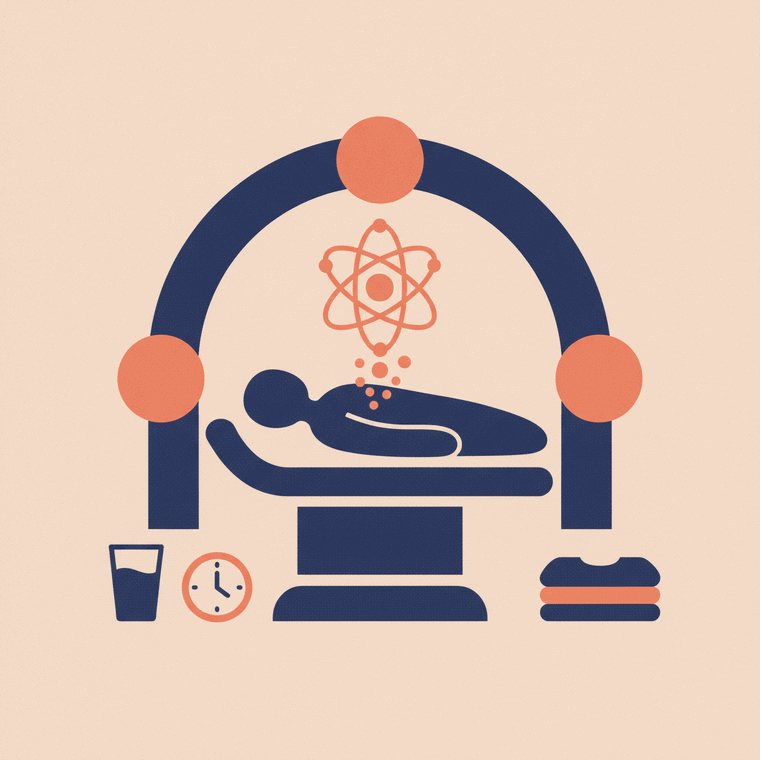
A PET scan needs more preparation than most. Because the common tracer (FDG) follows glucose, you'll usually be asked to fast for several hours, avoid strenuous exercise beforehand, and — if you have diabetes — have your blood sugar managed, so the tracer behaves predictably. After the injection there's a quiet rest period (often about an hour) before the scan. Always follow your centre's exact instructions, as they affect the accuracy of the scan.
Key takeaways
- You'll usually fast for several hours before a PET scan.
- Avoid strenuous exercise beforehand — it draws the tracer to muscles.
- Diabetes needs extra planning, as blood sugar affects the tracer.
- There's a quiet rest period after the injection, before the scan.
A PET scan usually needs more preparation than other scans — and it’s worth following closely, because it directly affects the quality of the images.[1]
Why the preparation matters
The common PET tracer, FDG, behaves like glucose (sugar) and is taken up by the body’s most active cells.[1] To make sure it goes where it’s meant to — rather than to busy muscles, or being thrown off by a recent meal — you’ll generally be asked to:
- Fast for several hours beforehand (plain water is usually encouraged);
- Avoid strenuous exercise in the day or so before, since active muscles soak up the tracer;
- If you have diabetes, plan ahead so your blood sugar is in a suitable range — high sugar competes with the tracer and can cloud the scan.
Your centre will give you specific instructions, which vary by the type of PET scan and what’s being investigated.
On the day
After the tracer is injected, there’s a quiet waiting period — often around an hour — while it distributes through your body.[1] You’ll usually be asked to rest quietly and stay warm (keeping warm stops the tracer collecting in “brown fat”). Then the scan itself is done. As with all nuclear medicine, tell the team if you are, or could be, pregnant or breastfeeding, and you may be asked to limit close contact with young children for a short time afterwards.
Frequently asked questions
Why do I have to fast before a PET scan?
Because the tracer follows glucose. Fasting keeps your blood sugar steady so the tracer goes to the tissues of interest, giving a clear, accurate scan.[1]
Why can’t I exercise before a PET scan?
Active muscles soak up the glucose-like tracer, which can obscure the areas doctors need to see. Resting beforehand keeps the tracer where it’s needed.[1]
Can I drive myself home afterwards?
Usually yes, as the scan itself doesn’t sedate you — but check with your centre, especially if you’ve had any medication. You may be advised to keep some distance from young children and pregnant people for a few hours as the tracer clears.[2]
Sources
- RadiologyInfo.org (RSNA & ACR) — General Nuclear Medicine (PET preparation) — www.radiologyinfo.org/en/info/gennuclear
- RANZCR / InsideRadiology — Nuclear medicine (Cain) — www.insideradiology.com.au/nuclear-medicine/