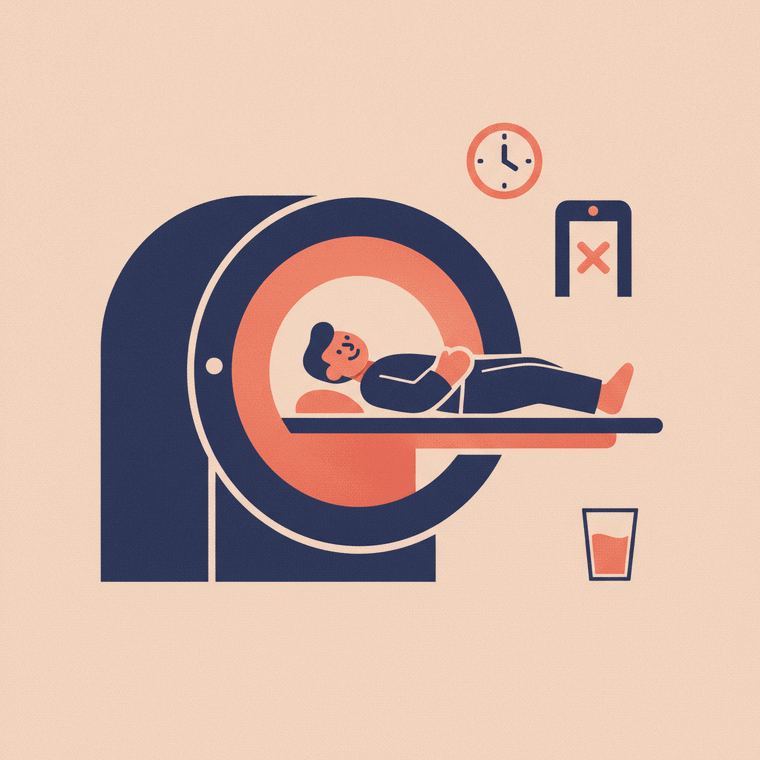
Most MRIs need very little preparation. The essential step is the safety screening: you'll complete a form and must declare every implant, device or piece of metal in your body, and whether you could be pregnant. Leave metal and valuables at home (you may change into a gown). A few MRIs — usually of the abdomen — require fasting, and if you're having contrast you may need a recent kidney blood test; your clinic will tell you. Bring your referral, Medicare card, any previous scans, and details of any implants.
Key takeaways
- The key prep is the metal/implant safety screening — declare everything.
- Most MRIs need no fasting; some abdominal scans do — follow your clinic's instructions.
- Bring implant/device details (make and model) so the team can confirm it's MRI-safe.
- If you're claustrophobic or having sedation, plan ahead — you can't drive after sedation.
The good news about MRI preparation is that there usually isn’t much of it — no special diet, no drinking a litre of liquid, often nothing at all the day before. But there is one step that really matters, plus a few specifics worth knowing so your scan isn’t delayed on the day.
The one that matters: the safety screening
Before any MRI, you’ll complete a safety screening form and go through it with the radiographer.[1] This is the single most important part of preparing, because the scanner’s magnet is extremely strong and always on.
Declare everything, including:[1][4]
- Implanted devices — pacemakers or defibrillators, cochlear (hearing) implants, neurostimulators, medication pumps
- Clips and metalwork — aneurysm clips, vascular clips, joint replacements, plates, pins, spinal rods
- Metal fragments — shrapnel or bullets, and any history of metal in the eye (important for metalworkers and welders)
- Whether you are, or might be, pregnant
If you have an implant, try to bring its make and model (an implant card, or details from your surgeon or GP). Many modern devices are “MRI-conditional” — safe under specific conditions — but only if the team knows exactly what you have.[1]
Metal to remove, and what to wear
You’ll be asked to take off anything metallic and often to change into a gown. Leave at home, or plan to remove:[1]
- Jewellery, watches, hairclips, glasses, hearing aids
- Phones, keys, coins, bank cards (the magnet can wipe the strip)
- Clothing with metal zips, buttons, underwire — and some activewear, which can contain metallic threads that heat up
- Make-up and nail polish near the scan area, as some contain metal particles
Do you need to fast?
For most MRIs, no. But some scans — typically of the abdomen (for example, the liver, bile ducts or bowel) — do require fasting for a few hours, and some need you to drink a special liquid.[2] Your clinic will give you specific instructions when you book. If you haven’t been told to fast, you can eat and drink normally.
If you’re having contrast
If your MRI uses gadolinium contrast, a small cannula goes into a vein for the injection.[1] Beforehand, tell the team if you have kidney problems (you may need a recent blood test), a previous reaction to gadolinium, or if you’re breastfeeding. Take your usual medications as normal unless told otherwise — unlike CT contrast, MRI contrast doesn’t involve the metformin precaution.
Claustrophobia and sedation
If enclosed spaces are difficult, raise it when you book, not on the day. Options include a wider or open scanner, a support person in the room, or a mild sedative.[1] If you have sedation, you can’t drive afterwards, so arrange for someone to take you home.
What to bring
- Your referral and Medicare card (and concession card, if you have one)
- Any previous scans or films of the same area — comparing helps the radiologist
- Implant/device details if relevant
- A list of your medications and allergies
Arrive 10–15 minutes early to complete the paperwork without rushing.
Frequently asked questions
Can I eat before an MRI?
For most MRIs, yes — eat and drink as normal. Only certain scans (often of the abdomen) require fasting, and your clinic will tell you in advance if yours does.[2]
What if I forget to mention an implant?
That’s exactly what the screening form and the radiographer’s questions are designed to catch — but always speak up. If something is discovered at the last minute, the scan may be paused while the team checks it’s safe. When in doubt, say so.[1]
Should I keep taking my medications?
Generally yes, take them as normal unless your doctor or the clinic tells you otherwise. Mention all medications on your form.[3]
Sources
- RadiologyInfo.org (RSNA & ACR) — MRI Safety — www.radiologyinfo.org/en/info/safety-mr
- RANZCR / InsideRadiology — Magnetic resonance imaging (MRI) — www.insideradiology.com.au/mri-hp/
- healthdirect — Magnetic resonance imaging (MRI) — www.healthdirect.gov.au/magnetic-resonance-imaging-mri
- StatPearls (NCBI) — MRI Contraindications — www.ncbi.nlm.nih.gov/books/NBK551669/