Yes — an MRI is very safe. It uses strong magnets and radio waves, not ionising radiation, so there's no radiation dose and no known tissue damage when it's done properly. The real safety issue isn't the scan itself — it's metal. Because the magnet is always on and extremely strong, anything magnetic (loose objects, some implants) must be identified first. Tell your radiographer about any implant, device or metal in your body, and whether you might be pregnant.
Key takeaways
- MRI uses magnets and radio waves — no ionising radiation, no dose that adds up.
- The magnet is always on; loose metal can become a projectile, so all metal is screened out first.
- Many modern implants (including some pacemakers) are 'MRI-conditional' — safe if the exact model is known.
- Gadolinium contrast is low-risk; tell your team about kidney problems, allergies or breastfeeding.
If you’ve been booked for an MRI, “is it safe?” is the natural first question — especially when the machine looks so imposing. The reassuring news: an MRI is one of the safest scans there is. But the reason it’s safe (and the one thing that genuinely matters for your safety) is different from what most people expect.
Why MRI is inherently safe: no radiation
Unlike an X-ray or CT, an MRI uses no ionising radiation at all. It works with a powerful magnetic field and radio waves, which line up and then “read” the water molecules in your body to build the image.[1] There’s no radiation dose, nothing that accumulates from one scan to the next, and no known tissue damage when the scan is done correctly.[1] That’s exactly why MRI is often preferred for children, in pregnancy, and any time a doctor wants detailed pictures without radiation.[2]
So the safety conversation for MRI isn’t really about the scan. It’s about metal.
The real issue: the magnet is always on
Here’s the part people underestimate. An MRI magnet is on 24/7 — even when no one is being scanned — and it is extraordinarily strong. Anything ferromagnetic (the kind of metal a fridge magnet sticks to) can be pulled toward the magnet suddenly and with real force.[1] That’s why MRI units are strictly controlled: no one carries keys, phones, oxygen bottles or scissors into the room.
For you as a patient, this translates into two things.
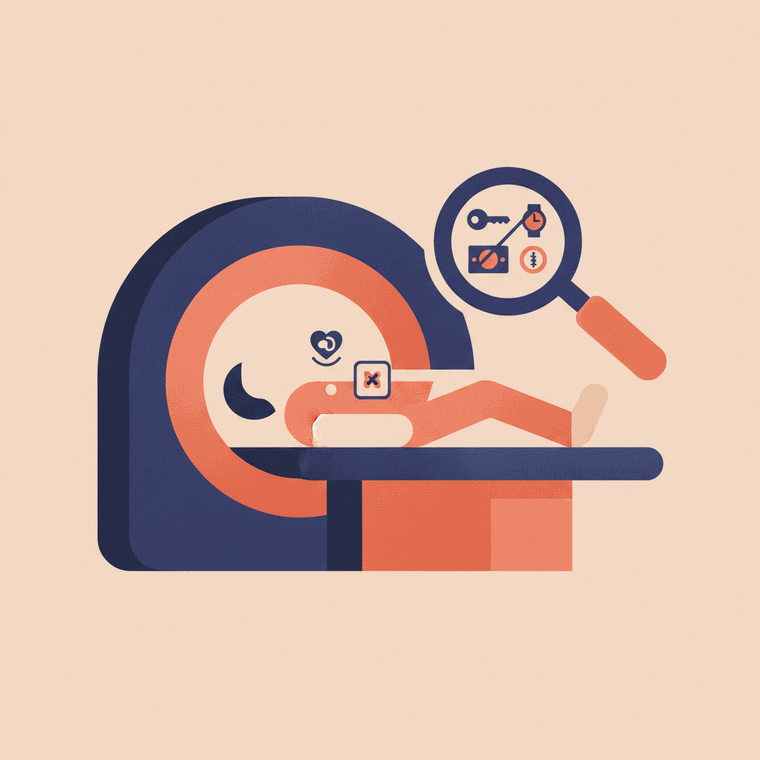
1. Remove all metal beforehand. You’ll usually change into a gown, and you’ll be asked to take off jewellery, watches, hairclips, glasses, hearing aids, and anything with metal fasteners.[1] A few less-obvious ones worth knowing:
- Bank cards and phones — the magnet can wipe magnetic strips and damage electronics, so leave them out of the room.[1]
- Some activewear — certain athletic fabrics contain metallic or antibacterial threads that can heat up in the scanner; that’s why many clinics insist on a gown.[1]
- Make-up, nail polish and some tattoos — a few contain metallic particles that can distort the image or, rarely, cause skin irritation near the scan area.[1]
2. Declare every implant and device. This is the single most important thing you can do. Before your scan you’ll complete a safety screening form and talk to the radiographer.[1]
Implants and devices: “MRI-conditional” is the key idea
Years ago, a pacemaker meant “no MRI.” That’s changed. Many modern devices are now “MRI-conditional” — meaning they’re safe to scan under specific conditions, provided the team knows the exact make and model and follows the manufacturer’s rules.[1]
Devices and objects your team needs to know about include:[1][4]
- Cardiac pacemakers and implantable defibrillators (ICDs)
- Aneurysm clips in the brain and other vascular clips
- Cochlear (hearing) implants and neurostimulators
- Implanted medication pumps (insulin, pain relief, chemotherapy)
- Metal fragments — shrapnel, bullets, or metal near the eye (a risk for metalworkers)
The reason it matters: a magnetic implant can move, an implant can heat up from the radio waves, or it can create a bright “artefact” that obscures the picture.[1] In rare cases — a ferromagnetic aneurysm clip, for instance — the scan may be cancelled for safety.[1] If you don’t know the details of your implant, your GP, surgeon or the device card you were given can supply the model number. When in doubt, say so — the whole screening system exists to catch exactly this.
Contrast dye (gadolinium): low-risk, with a few flags
Some MRIs use a contrast agent called gadolinium, injected into a vein to make certain tissues stand out. Importantly, gadolinium does not contain iodine, so it rarely causes the allergic reactions people associate with CT dye.[1] Still, tell your team before contrast if you have:[1]
- Kidney disease, kidney failure or a transplant (the kidneys clear gadolinium)
- A previous reaction to gadolinium
- Liver disease
Many MRIs don’t need contrast at all — your radiologist decides based on the question being asked.
Claustrophobia is common — and manageable
The MRI tunnel is enclosed and noisy, and feeling anxious is normal. Roughly 1 in 20 people need a mild sedative to get through comfortably.[1] Good options to raise before the day:
- Ask about a wider or more open scanner — many Australian practices have them.
- Ask whether a support person can stay in the room.
- Ask about sedation if you know enclosed spaces are difficult for you (you’ll need someone to drive you home).
- You’ll get earplugs or headphones for the noise, a call button, and the radiographer watches and talks to you the whole time.[1]
Being prepared and knowing what to expect is often enough to complete the scan.
Pregnancy and breastfeeding
Pregnancy: there is no known risk from MRI in pregnancy, and it’s generally safer for the baby than an X-ray or CT because there’s no radiation.[1] As a precaution, a non-urgent scan may be deferred, and contrast is usually avoided — the evidence on gadolinium in pregnancy is reassuring but not complete, so it’s used only when the benefit clearly justifies it.[5] Always tell your team if you are, or might be, pregnant.
Breastfeeding: it’s considered safe to keep breastfeeding after gadolinium. Some parents choose to pump and discard for 12–24 hours out of caution, but this isn’t medically required.[1]
Don’t forget the risk of not scanning
It’s easy to focus on the small risks of having an MRI and forget the other side of the ledger. Declining a genuinely needed scan carries its own risk — a delayed or missed diagnosis.[1] If a clinic can’t scan you because of an implant, ask whether an alternative (CT or ultrasound) would work, or whether a specialist MRI centre has the expertise to scan you safely.[1]
In an Australian clinic: what actually happens
You’ll be screened with a form and a chat with the radiographer (the health professional who runs the scanner), change into a gown, and confirm any implants. The scan itself is painless and takes about 15–45 minutes, sometimes longer. You lie still on a padded table that slides into the tunnel, with earplugs and a call button, and you can talk to the radiographer throughout.[1][2] Afterwards a radiologist interprets the images and reports to your referring doctor.
Frequently asked questions
Can I have an MRI with a pacemaker?
Often, yes — many modern pacemakers are MRI-conditional and can be scanned safely if the team knows the exact model and follows the required precautions. Older or non-conditional devices may rule it out. Your cardiologist and the MRI centre decide together.[1]
Will the MRI hurt or make me feel anything?
No — MRI is painless and you won’t feel the magnetic field. The main things you’ll notice are the loud tapping noise (you’ll have ear protection) and lying still in an enclosed space.[1]
I have tattoos — is that a problem?
Usually not, but some older or larger tattoos contain metallic pigments that can warm slightly or distort a nearby image. Mention tattoos on your screening form, especially if they’re near the area being scanned.[1]
Is MRI safe to have more than once?
Yes. Because there’s no radiation, there’s no cumulative dose to worry about, so repeated MRIs don’t carry the “how many is too many” concern that applies to X-rays and CT.[2]
Sources
- RadiologyInfo.org (RSNA & ACR) — MRI Safety — www.radiologyinfo.org/en/info/safety-mr
- RANZCR / InsideRadiology — Magnetic resonance imaging (MRI) — www.insideradiology.com.au/mri-hp/
- ARPANSA — Magnetic resonance imaging (MRI) — www.arpansa.gov.au/understanding-radiation/radiation-sources/more-radiation-sources/mri
- StatPearls (NCBI) — Magnetic Resonance Imaging Contraindications — www.ncbi.nlm.nih.gov/books/NBK551669/
- Winter et al. (2023), gadolinium in pregnancy — MRI safety literature review — pmc.ncbi.nlm.nih.gov/articles/PMC10237509/
- healthdirect — Magnetic resonance imaging (MRI) — www.healthdirect.gov.au/magnetic-resonance-imaging-mri